
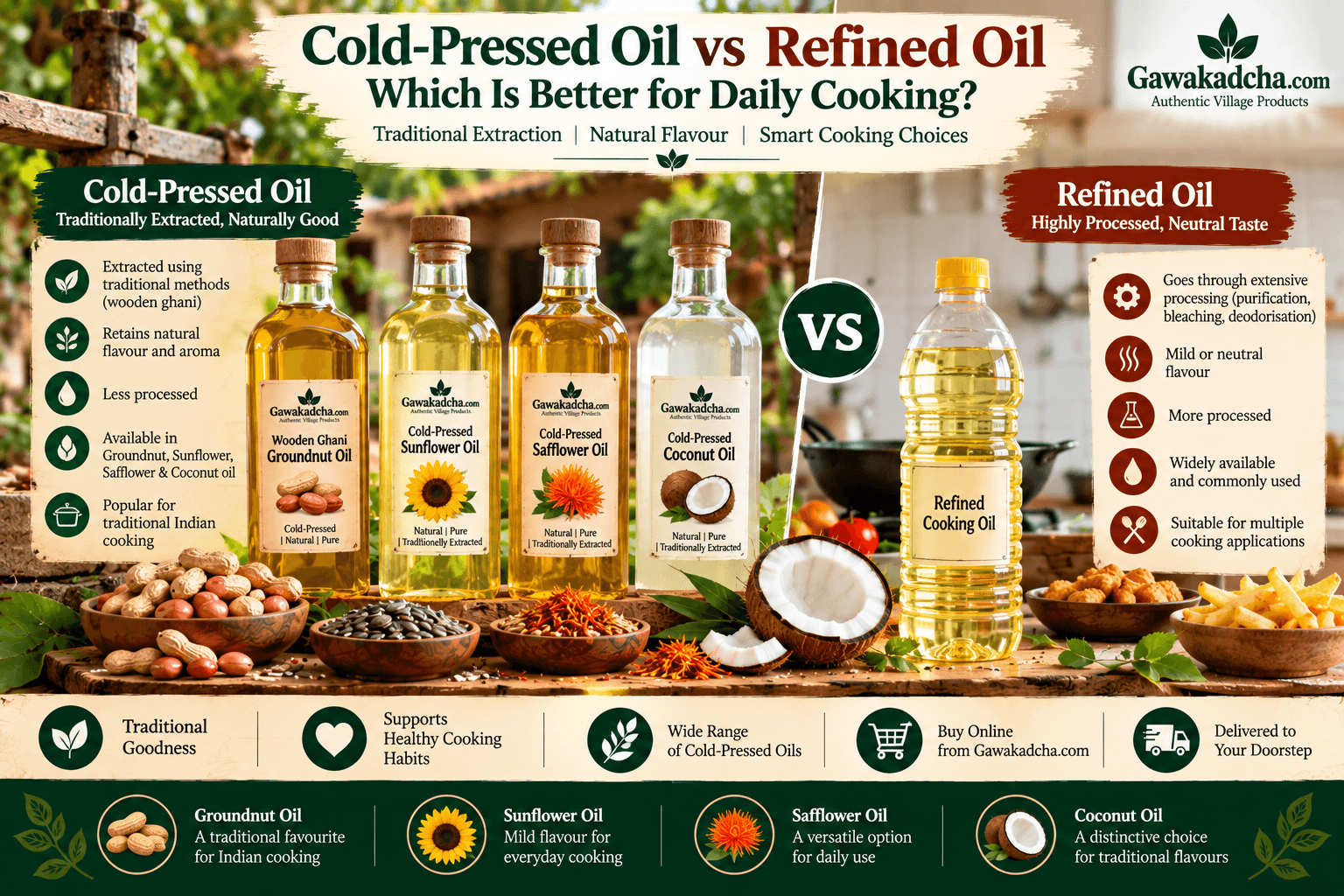
Cold-Pressed Oil vs Refined Oil: Which Is Better for Daily Cooking?
Cold-Pressed • Traditional Extraction • Refined Oil • Smart Cooking Choices
Cooking oil is one of the most frequently used ingredients in Indian kitchens. From frying and sautéing to preparing tadka, curries, bhakri and traditional Maharashtrian dishes, the choice of cooking oil can influence the taste, texture and overall cooking experience.
With so many options available today, one common question is:
Cold-Pressed Oil vs Refined Oil — which is better for daily cooking?
Cold-pressed oils have become increasingly popular among consumers looking for traditionally extracted cooking oils. At the same time, refined oils remain widely used because of their availability, neutral flavour, affordability and versatility.
But choosing between the two should not be based only on marketing claims.
It is important to understand how the oils are produced, what type of oil it is, how it fits your cooking method and what the product label says.
In this guide, we'll compare cold-pressed oil and refined oil, explain the differences between them and help you understand which options may suit different types of Indian cooking.
What Is Cold-Pressed Oil?
Cold-pressed oil is produced by mechanically pressing oilseeds, nuts or other oil-bearing ingredients to extract their oil, generally without relying on solvent extraction.
Traditional methods include wooden-press or wooden ghani oil extraction, which has been used in India for generations.
Common cold-pressed cooking oils include:
Cold-pressed groundnut oil
Cold-pressed sunflower oil
Cold-pressed safflower oil
Cold-pressed coconut oil
Sesame oil
Mustard oil
The characteristics of cold-pressed oil can vary depending on the seed or nut, extraction method, storage conditions and filtration or processing used after extraction.
One noticeable feature is that many cold-pressed oils retain a more distinct natural flavour and aroma compared with highly refined oils.
What Is Refined Oil?
Refined oil goes through additional processing designed to remove or reduce substances that can affect the oil's colour, flavour, odour, stability or suitability for particular applications.
Depending on the oil and manufacturing process, refining can involve stages such as purification, neutralisation, bleaching and deodorisation.
The result is generally an oil with:
Lighter colour
More neutral flavour
Reduced natural aroma
Consistent appearance
Characteristics suitable for many cooking applications
Refined oils are widely available and are used in homes, restaurants and food manufacturing.
It is important to understand that "refined" does not automatically mean unhealthy, just as "cold-pressed" does not automatically mean healthier in every situation.
The type of oil and its overall fatty-acid profile also matter.
Cold-Pressed Oil vs Refined Oil: At a Glance
Feature | Cold-Pressed Oil | Refined Oil |
|---|---|---|
Extraction | Mainly mechanical pressing | More extensive processing |
Flavour | Often more noticeable | Usually more neutral |
Aroma | Often characteristic of the source | Generally mild |
Processing | Typically less intensive | More intensive |
Traditional appeal | High | Lower |
Cooking versatility | Depends on the oil | Generally versatile |
Nutritional profile | Depends on the source oil | Depends on the source oil |
Appearance | Can vary naturally | Usually more uniform |
Best choice | Depends on oil and cooking needs | Depends on oil and cooking needs |
The most important point is that there is no single cooking oil that is best for everyone or every dish.
Why Are Cold-Pressed Oils Becoming Popular?
The renewed interest in cold-pressed oils is closely connected with the growing interest in traditional food practices.
Consumers are increasingly curious about:
Traditional food preparation
Minimally processed foods
Regional ingredients
Wooden ghani oil
Natural flavours
Traditional Indian cooking methods
For many people, cold-pressed oil also provides a stronger connection to traditional cooking.
A cold-pressed groundnut oil, for example, can have a characteristic nutty aroma that works particularly well with certain Indian dishes.
Similarly, coconut oil has a distinctive flavour profile that can complement recipes where coconut is traditionally used.
1. Cold-Pressed Oil Retains a Distinctive Flavour
One of the easiest differences to notice is flavour.
Cold-pressed oils often retain more of the characteristic taste and aroma of their source ingredient.
For example:
Groundnut Oil
Often has a mild nutty character and works well in many Indian preparations.
Coconut Oil
Has a distinctive coconut aroma and is commonly associated with several regional cuisines.
Sunflower Oil
Generally has a relatively mild flavour, making it suitable for everyday cooking where a neutral taste is preferred.
Safflower Oil
Has a comparatively mild flavour and can be used in a variety of cooking applications.
The right choice depends on whether you want the oil to contribute its own flavour to the dish.
2. Cold-Pressed Oil Can Complement Traditional Indian Cooking
Indian cooking is incredibly diverse.
A single kitchen may prepare:
Dal
Sabzi
Pulao
Bhakri
Paratha
Pickles
Snacks
Curries
Traditional Maharashtrian dishes
Different oils can work differently with different foods.
For traditional recipes, many consumers prefer oils that contribute some natural aroma and flavour.
This is one reason cold-pressed cooking oils have found renewed interest among people who enjoy traditional food.
3. Groundnut Oil for Everyday Indian Cooking
Cold-pressed groundnut oil is one of the popular choices for Indian kitchens.
It can be used for applications such as:
Sautéing
Tempering
Vegetable preparations
Traditional snacks
Regional cooking
Its characteristic nutty flavour can complement many Indian dishes.
Groundnut oil is also a familiar traditional cooking oil in several parts of India.
When choosing it, check the product label and ensure that the oil is appropriate for your intended cooking method.
4. Sunflower Oil for Mild-Flavoured Cooking
Sunflower oil is known for its relatively mild taste.
This can make it useful when you don't want a strong oil flavour to dominate the dish.
Cold-pressed sunflower oil can be considered for:
Everyday sabzi
Sautéing
Light cooking
Traditional recipes where a mild oil flavour is preferred
As with any cooking oil, the nutritional characteristics depend on the specific oil and its fatty-acid composition.
5. Safflower Oil as Another Traditional Option
Safflower oil is another oil that Indian households may consider for cooking.
Cold-pressed safflower oil generally has a mild flavour and can be used in a variety of everyday preparations.
The key is to consider the oil's characteristics alongside the type of food you are preparing.
Instead of asking:
"Which oil is the healthiest?"
a better question is:
"Which oil suits my cooking style, dietary needs and overall eating pattern?"
6. Coconut Oil for Traditional Flavours
Coconut oil has a distinctive identity.
It is commonly associated with cuisines where coconut and coconut-based preparations are important ingredients.
Cold-pressed coconut oil can be used for:
Traditional cooking
Sautéing
Certain regional recipes
Preparations where coconut flavour complements the dish
Because its flavour is noticeable, it may not be the first choice when a completely neutral-tasting oil is preferred.
Does Cold-Pressed Oil Have More Nutrients?
This is where it is important to avoid oversimplification.
Cold-pressed oils can retain some naturally occurring minor components because they generally undergo less intensive processing than refined oils.
However, this does not mean every cold-pressed oil is automatically nutritionally superior to every refined oil.
The nutritional profile of an oil depends heavily on the source:
Groundnut ≠ Sunflower ≠ Safflower ≠ Coconut
Each has a different fatty-acid composition.
Therefore, when evaluating cooking oil, look beyond the words "cold-pressed" and consider the actual type of oil.
Is Refined Oil Bad for Cooking?
Not necessarily.
Refined oils are widely used because refining can improve characteristics such as:
Neutral flavour
Colour consistency
Stability
Suitability for different food applications
The important consideration is not simply whether an oil is refined.
You should consider:
What type of oil it is
Its fatty-acid profile
How much you consume
How you use it
Your overall diet
Calling all refined oils "bad" is an oversimplification.
Likewise, assuming every cold-pressed oil is automatically healthy is also an oversimplification.
Which Is Better for Daily Cooking?
The answer depends on your requirements.
Choose Cold-Pressed Oil If You Prefer:
Traditionally extracted oils
Characteristic natural flavour
Regional cooking styles
Wooden ghani-style oils
Less intensively processed options
Oils with distinctive aroma
Refined Oil May Suit You If You Prefer:
Neutral flavour
Consistent appearance
Broad cooking versatility
A specific oil formulation suitable for your cooking needs
Easy availability
The choice is ultimately personal and should be based on the specific oil rather than the processing label alone.
Cold-Pressed Oil for Indian Cooking: Which One Should You Choose?
There is no universal winner.
Instead, think about the type of oil.
Groundnut Oil
A good option when you want a traditional nutty flavour for everyday Indian cooking.
Sunflower Oil
Useful when you prefer a relatively mild oil flavour.
Safflower Oil
A mild-flavoured option that can fit a variety of cooking styles.
Coconut Oil
A distinctive choice for recipes where coconut flavour works well.
The best approach is to understand each oil rather than choosing solely based on whether it is cold-pressed or refined.
Cold-Pressed Oil vs Refined Oil for Maharashtrian Cooking
Maharashtrian cuisine includes a wide variety of flavours and cooking styles.
Traditional dishes may include:
Bhakri
Pithla
Bharit
Usal
Amti
Vegetable preparations
Pickles
Traditional snacks
Groundnut oil is particularly familiar in many Maharashtrian cooking traditions.
A cold-pressed groundnut oil can add a characteristic flavour to everyday dishes.
For consumers interested in traditional cooking, this is one reason wooden ghani groundnut oil continues to attract attention.
Does the Cooking Method Matter?
Yes.
The suitability of an oil depends partly on how you plan to use it.
Different cooking methods include:
Low-temperature cooking
Sautéing
Tempering
Baking
Shallow frying
Deep frying
Different oils have different properties.
Therefore, don't assume that one oil is ideal for every cooking method.
If you regularly use high-heat cooking, check the manufacturer's guidance and the oil's specifications.
For everyday cooking, using appropriate heat and avoiding overheating or repeatedly reusing cooking oil are sensible practices.
Why You Should Avoid Reusing Cooking Oil Repeatedly
Regardless of whether you use refined or cold-pressed oil, repeatedly heating the same cooking oil can cause undesirable chemical changes.
This is particularly relevant for deep-frying.
Instead of repeatedly reheating leftover oil, consider:
Using an appropriate quantity
Avoiding unnecessary overheating
Storing oils correctly
Following product-specific guidance
Limiting repeated reuse
Good cooking practices matter just as much as the choice of oil.
How to Store Cooking Oil Properly
Even a good-quality oil needs proper storage.
Keep cooking oil:
Tightly closed
Away from direct sunlight
Away from excessive heat
In a suitable container
According to the manufacturer's storage instructions
Heat, light and exposure to air can affect oil quality over time.
Always check the product label for recommended storage conditions.
How to Choose Good Cold-Pressed Oil Online
If you're planning to buy cold-pressed oil online, don't choose based only on the word "cold-pressed."
Check:
1. Type of Oil
Is it groundnut, sunflower, safflower, coconut or another oil?
2. Extraction Method
Does the product clearly explain how the oil is extracted?
3. Ingredients
Check whether the product contains only the expected oil or has additional ingredients.
4. Quantity
Compare pack sizes carefully.
5. Packaging
Choose packaging appropriate for protecting the oil from light and damage.
6. Product Information
Check the label and manufacturer details.
7. Storage Instructions
Understand how the oil should be stored after purchase.
8. Customer Reviews
Read genuine customer feedback where available.
9. Seller Transparency
Buy from a seller or marketplace that provides clear product information.
Why Wooden Ghani Oil Is Attracting Attention
The term wooden ghani oil refers to oil produced using a traditional wooden-press extraction approach.
For many consumers, the attraction comes from the combination of:
Traditional Extraction + Distinctive Flavour + Familiar Food Culture
Wooden ghani oils can therefore appeal to customers who want to explore traditional Indian cooking practices.
However, consumers should still check the actual product details and processing information rather than assuming every product marketed as "ghani" is identical.
Cold-Pressed Oil vs Refined Oil: The Smart Consumer Approach
Instead of treating this as a simple battle between two categories, think about it as a decision involving three factors:
1. Processing
How was the oil produced?
2. Source
What oilseed, nut or fruit was used?
3. Usage
How will you use the oil?
This approach gives you a much more practical answer.
For example:
Cold-Pressed Groundnut Oil
may be attractive for someone who enjoys traditional Indian cooking and wants a characteristic nutty flavour.
Refined Sunflower Oil
may appeal to someone looking for a more neutral flavour.
Neither statement means that one is universally better for every person.
Why Gawakadcha.com Offers Traditional Cold-Pressed Oils
For customers interested in traditional Indian food products, Gawakadcha.com brings together different regional and traditional food categories in one online marketplace.
Its cold-pressed oil range includes:
Wooden Ghani Groundnut Oil
Wooden Ghani Sunflower Oil
Wooden Ghani Safflower Oil
Wooden Ghani Coconut Oil
These oils provide customers with different flavour profiles and options for everyday cooking.
Instead of choosing an oil only because it is labelled "healthy," customers can explore the characteristics of each oil and select the one that fits their cooking preferences.
The larger idea is consistent with Gawakadcha.com's focus on bringing traditional Indian food products closer to modern customers.
Benefits of Buying Cold-Pressed Oil Online
Buying cold-pressed oil online can be convenient when the product information is clearly presented.
Customers can:
Compare different oils
Check pack sizes
Read product descriptions
Explore customer reviews
Discover traditional oils
Order from home
Explore regional food products alongside other groceries
For customers who have moved from villages or smaller towns to cities, online shopping can also make familiar traditional products easier to access.
Common Myths About Cold-Pressed and Refined Oils
Myth 1: All Cold-Pressed Oils Are Automatically Healthy
Reality: The source oil and its fatty-acid profile matter. "Cold-pressed" describes processing, not a universal health rating.
Myth 2: All Refined Oils Are Unhealthy
Reality: Refining changes the oil's characteristics, but the nutritional properties depend on the specific oil.
Myth 3: Expensive Oil Is Always Better
Reality: Price alone does not determine quality.
Myth 4: One Oil Is Best for Every Dish
Reality: Different oils have different flavour and cooking characteristics.
Myth 5: Traditional Means Healthier
Reality: Traditional foods can be valuable culturally, but nutritional quality still depends on ingredients, quantity and overall diet.
Simple Guide: Which Oil Should You Choose?
Your Preference | Oil to Consider |
|---|---|
Traditional nutty flavour | Cold-pressed Groundnut Oil |
Mild flavour | Cold-pressed Sunflower Oil |
Mild traditional oil option | Cold-pressed Safflower Oil |
Distinctive coconut flavour | Cold-pressed Coconut Oil |
Neutral cooking experience | Suitable refined oil |
Traditional-style extraction | Wooden Ghani / Cold-Pressed Oil |
This table is a starting point, not a medical recommendation.
Your individual dietary needs and cooking habits should always guide your final choice.
Frequently Asked Questions
Is cold-pressed oil better than refined oil?
Not universally. Cold-pressed and refined oils differ in processing and flavour, while the nutritional profile also depends on the specific oil. Choose based on the type of oil, cooking method and your dietary preferences.
Is cold-pressed oil good for daily cooking?
Cold-pressed oils can be used for daily cooking when the specific oil is appropriate for the cooking method and is used according to the product's instructions.
Which cold-pressed oil is best for Indian cooking?
There is no single best option. Groundnut, sunflower, safflower and coconut oils have different characteristics. Groundnut oil is particularly suitable for consumers who enjoy a traditional nutty flavour.
Is wooden ghani oil the same as cold-pressed oil?
Wooden ghani generally refers to a traditional mechanical extraction method. Product-specific processing can vary, so check the manufacturer's description and label.
Is refined oil unhealthy?
Refined oil is not automatically unhealthy. The type of oil, its fatty-acid composition, quantity consumed and overall diet are important considerations.
Which cold-pressed oil is best for Maharashtrian cooking?
Cold-pressed groundnut oil is a natural option to consider for many Maharashtrian-style preparations because of its familiar flavour and traditional association with Indian cooking.
Can cold-pressed oil be used for frying?
The suitability depends on the specific oil and the frying method. Check the manufacturer's recommendations and avoid overheating or repeatedly reusing cooking oil.
How should cold-pressed oil be stored?
Store it in a tightly closed container away from excessive heat and direct light, and follow the storage instructions provided on the product label.
Where can I buy cold-pressed oil online?
You can explore cold-pressed groundnut, sunflower, safflower and coconut oils on Gawakadcha.com, subject to product availability and delivery coverage.
Conclusion
The debate between cold-pressed oil vs refined oil does not have a one-size-fits-all answer.
Cold-pressed oils appeal to consumers who appreciate traditional extraction methods, characteristic flavours and the connection with traditional Indian cooking.
Refined oils can offer neutral flavour, consistency and versatility for many cooking applications.
The smarter approach is to look beyond the label.
Consider:
What type of oil is it?
How was it processed?
What does it taste like?
How will you use it?
What does the product label say?
For customers who enjoy traditional Indian cooking, cold-pressed groundnut, sunflower, safflower and coconut oils can offer different flavour experiences for everyday meals.
At Gawakadcha.com, these traditional-style oils are part of a broader collection of products that connects modern customers with regional Indian food traditions.
Because choosing cooking oil isn't only about following a trend.
It is about understanding your options and selecting an oil that fits your cooking style, food preferences and everyday kitchen needs.
Traditional Extraction • Authentic Flavour • Smart Cooking Choices • Everyday Indian Kitchen
Explore traditional cold-pressed oils and other regional food products at Gawakadcha.com.