
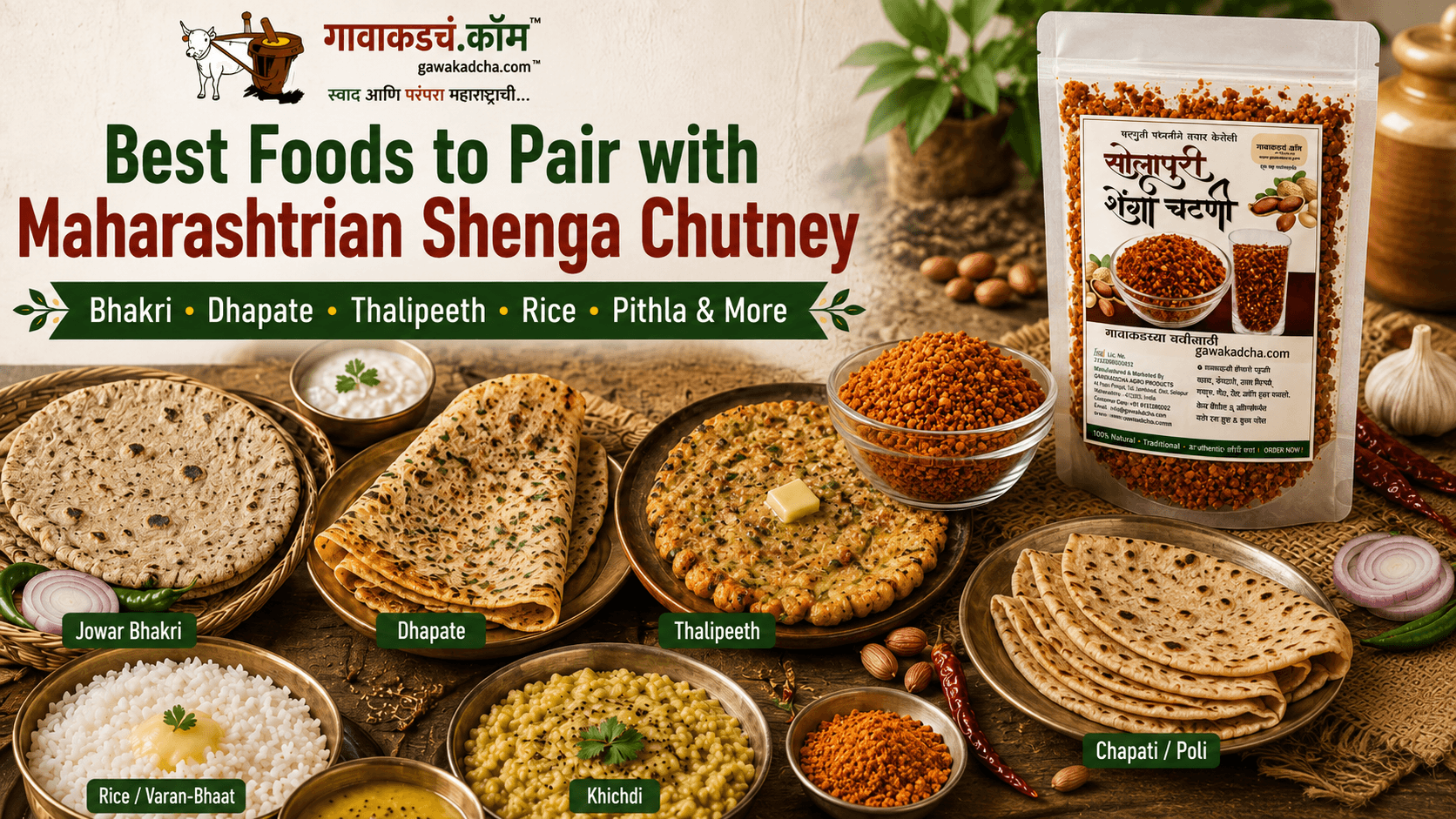
Best Foods to Pair with Maharashtrian Shenga Chutney: 12 Delicious Combinations to Try
Few accompaniments can transform a simple Maharashtrian meal as quickly as Shenga Chutney.
Also known as Shengdana Chutney, Peanut Chutney, Groundnut Chutney or Solapuri Shenga Chutney, this dry, spicy condiment is especially popular in Maharashtra for its roasted peanut flavour, garlic aroma and chilli heat.
Gawakadcha’s current Solapuri Shenga Chutney is prepared with roasted peanuts, garlic cloves, Solapuri dry red chillies and salt. Its product instructions recommend serving it with Bhakri, Chapati or Rice.
But Shenga Chutney can do much more than accompany Bhakri.
From Dhapate and Thalipeeth to Varan-Bhaat, Pithla and Khichdi, here are some of the best foods to pair with Maharashtrian Shenga Chutney.
What Is Maharashtrian Shenga Chutney?
Shenga Chutney is a traditional dry chutney made primarily from roasted groundnuts.
Depending on the region and household recipe, it may contain:
Roasted peanuts
Garlic
Dry red chilli
Salt
Cumin
Sesame seeds
Other regional seasonings
The texture is generally coarse rather than completely smooth.
Its flavour can be described as:
Nutty • Spicy • Garlicky • Savoury • Rustic
Maharashtra Tourism notes that Bhakri, Thecha, chutneys and pickles form an important part of traditional diets in central Maharashtra, where crops such as Jowar, Bajra and Harbhara are widely used.
This makes peanut-based chutneys a natural fit with Maharashtra’s millet-rich food culture.
12 Best Foods to Eat with Shenga Chutney
1. Jowar Bhakri
If there is one pairing that represents the rustic character of Maharashtrian food, it is:
Jowar Bhakri + Shenga Chutney
The earthy flavour of Jowar works beautifully with roasted peanuts, garlic and chilli.
To make the meal even better, add:
Raw onion
Green chilli
Curd
Buttermilk
Seasonal vegetable
The soft Bhakri balances the dry, spicy chutney and makes it easy to enjoy a small amount in every bite.
Gawakadcha also recommends Shenga Chutney specifically with Bhakri.
Related SEO searches: Shenga Chutney with Bhakri, Jowar Bhakri Chutney, Maharashtrian village food
2. Bajra Bhakri
Bajra Bhakri has a deeper, slightly stronger grain flavour than ordinary wheat roti.
That makes it another excellent base for a bold dry chutney.
Try:
Hot Bajra Bhakri + Shenga Chutney + White Butter or Curd
This combination works especially well during cooler months when Bajra-based meals are commonly enjoyed.
The nuttiness of both Bajra and groundnut creates a satisfying regional flavour.
3. Hurdyache Dhapate
Dhapate is one of the best modern pairings for Solapuri Shenga Chutney.
A freshly cooked Dhapate already contains a mix of grains, pulses, spices and herbs.
Adding peanut chutney introduces:
Roasted flavour
Garlic
Chilli heat
Additional texture
A simple serving idea is:
Hot Dhapate + Curd + Shenga Chutney
This works particularly well for breakfast, lunch or a quick evening meal.
If you use ready-to-make Hurdyache Dhapate Pith, the combination also creates a convenient way to enjoy two regional Maharashtrian products together.
4. Thalipeeth
Traditional Thalipeeth is prepared using Bhajani flour containing combinations of roasted grains and pulses.
Its slightly crisp exterior and soft centre make it ideal for dry chutneys.
Serve:
Thalipeeth + Curd + Shenga Chutney
or
Thalipeeth + White Butter + Peanut Chutney
Maharashtra Tourism identifies Thalipeeth as a traditional multigrain preparation made using ingredients such as gram, Bajra, wheat and Jowar.
Because both Thalipeeth and Shenga Chutney carry roasted flavours, the pairing feels naturally complementary.
5. Chapati or Poli
Shenga Chutney does not need an elaborate meal.
One of the easiest combinations is:
Hot Chapati + Shenga Chutney + Ghee
or simply:
Chapati Roll with Shenga Chutney
Spread a small amount of chutney on a fresh Chapati, add a little ghee or curd if desired and roll it.
This makes a quick:
Breakfast
Tiffin option
Travel snack
Light evening meal
Gawakadcha’s product instructions also recommend the chutney with Chapati.
6. Pithla Bhakri
Pithla Bhakri is already one of Maharashtra’s most recognisable village-style meals.
Adding Shenga Chutney creates another flavour layer.
The plate can include:
Jowar Bhakri
Pithla
Shenga Chutney
Raw onion
Green chilli
Pickle
Pithla is comparatively soft and smooth, while the dry peanut chutney adds texture and stronger roasted flavour.
For anyone exploring authentic Maharashtrian village food, this is one combination worth trying.
7. Zunka Bhakri
Zunka is a drier gram-flour preparation than Pithla.
It has a crumbly texture and works particularly well with Bhakri.
Adding a small spoonful of Shenga Chutney can create a much bolder plate.
Try:
Zunka + Jowar Bhakri + Shenga Chutney + Onion
Since both Zunka and the chutney have strong savoury flavours, start with a small quantity of chutney and adjust according to taste.
8. Varan-Bhaat or Dal-Rice
Shenga Chutney is not only for flatbreads.
It can also transform a simple bowl of rice.
Gawakadcha specifically mentions Rice as one of the recommended pairings for its Solapuri Shenga Chutney.
Try:
Hot Rice + Varan + Ghee + Shenga Chutney
The mildness of Varan-Bhaat creates a good contrast with the spicy garlic-and-peanut flavour.
A simple home-style plate may include:
Varan-Bhaat
Vegetable
Shenga Chutney
Pickle
Papad
This is one of the easiest ways to use the chutney as an everyday condiment.
9. Khichdi
Soft, mild Khichdi is an ideal base for stronger accompaniments.
A spoonful of Shenga Chutney adds:
Crunchy/coarse texture
Chilli heat
Garlic flavour
Peanut richness
Try it with:
Moong Dal Khichdi
Rice Khichdi
Millet Khichdi
Vegetable Khichdi
Serve with curd if you want to balance the spice.
Khichdi + Curd + Shenga Chutney is a quick combination for days when you want something simple but flavourful.
10. Poha
This may not be the first pairing people think of, but Shenga Chutney can work surprisingly well with Kanda Poha.
Peanuts are already commonly used in Poha, so a small sprinkle of dry peanut chutney can intensify the same flavour family.
Try adding only a little over freshly prepared Poha along with:
Coriander
Lemon
Onion
Because the chutney contains salt and chilli, reduce additional seasoning if necessary.
This is particularly useful for people who enjoy spicy breakfast foods.
11. Curd Rice or Plain Curd with Rice
Spicy Shenga Chutney works well against cooling curd.
A small amount mixed into:
Rice + Curd
can turn a mild meal into something much more interesting.
You can also make a quick chutney-curd accompaniment:
Plain Curd + Small Amount of Shenga Chutney
Mix lightly and serve with:
Bhakri
Dhapate
Thalipeeth
Chapati
This also helps moderate the chilli intensity for people who prefer a milder taste.
12. Simple Vegetable Meals
Shenga Chutney can rescue an ordinary vegetable meal without requiring another gravy.
It works especially well alongside:
Potato Bhaji
Brinjal preparations
Methi Bhaji
Green leafy vegetables
Mixed vegetables
Simple dry Sabzi
A plate of:
Bhakri + Seasonal Bhaji + Shenga Chutney
is simple, practical and strongly connected with Maharashtrian home-style eating.
Quick Shenga Chutney Pairing Ideas
If you want easy combinations, try these:
Breakfast:
Dhapate + Curd + Shenga Chutney
Traditional Lunch:
Jowar Bhakri + Pithla + Shenga Chutney + Onion
Quick Lunch:
Varan-Bhaat + Ghee + Shenga Chutney
Light Dinner:
Thalipeeth + Curd + Shenga Chutney
Tiffin:
Chapati + Shenga Chutney Roll
Comfort Meal:
Moong Dal Khichdi + Curd + Shenga Chutney
How Much Shenga Chutney Should You Use?
Shenga Chutney is highly flavourful, so you generally do not need a large quantity.
Start with:
1–2 teaspoons as an accompaniment
and adjust according to taste and the specific product.
This is particularly important because dry chutneys may contain salt and chilli.
Treat the chutney as a condiment rather than the main part of the meal.
Is Shenga Chutney Healthy?
Peanuts naturally provide protein, unsaturated fats and several nutrients.
However, the nutritional value of a finished chutney depends on:
Ingredient proportions
Salt
Serving size
Preparation method
Therefore, Shenga Chutney should not be marketed as a miracle health product.
Its biggest practical strengths are:
Strong flavour
Peanut-based ingredients
Convenience
Traditional culinary value
People with peanut allergies must avoid Shenga Chutney containing groundnuts.
Anyone advised to limit sodium should also check the salt content and portion size.
Why Solapuri Shenga Chutney Tastes Different
Solapur is strongly associated with dry, bold and spicy food traditions.
Gawakadcha’s current Solapuri Shenga Chutney contains just four declared ingredients:
Roasted Peanuts, Garlic Cloves, Solapuri Dry Red Chillies and Salt.
This simple combination creates its characteristic:
Roasted + Garlicky + Spicy + Nutty
taste.
The product is made by Rajnandini Masale in Solapur and is currently offered in 200 g and 500 g pack variations.
How to Store Shenga Chutney
Because dry chutney can lose freshness when exposed to moisture and air, storage matters.
Gawakadcha currently recommends:
Store in a cool, dry place.
Keep away from moisture.
Keep the pouch tightly sealed after use.
Use a clean, dry spoon whenever possible.
If the chutney develops an unusual odour, visible moisture or spoilage, do not consume it.
Why Shenga Chutney Is Perfect for Modern Kitchens
Traditional foods sometimes disappear because modern households do not have time to prepare every component from scratch.
A ready dry chutney solves part of that problem.
You can turn:
Plain Chapati → Flavourful Roll
Simple Dal-Rice → Maharashtrian-style Meal
Dhapate → Complete Breakfast
Bhakri + Bhaji → Rustic Village Plate
in seconds.
This is why regional chutneys have strong potential in modern urban kitchens: they offer traditional taste without requiring another full recipe.
Frequently Asked Questions
What is Shenga Chutney?
Shenga Chutney is a Maharashtrian dry peanut chutney commonly made using roasted groundnuts, garlic, chilli and salt.
What is the best food to eat with Shenga Chutney?
Jowar Bhakri is one of the most traditional and popular combinations. Chapati, Rice, Dhapate, Thalipeeth, Pithla and Khichdi also pair well with it.
Is Shenga Chutney the same as Shengdana Chutney?
Yes. Shenga and Shengdana both refer to peanuts/groundnuts in common Maharashtrian usage.
Can I eat Shenga Chutney with rice?
Yes. Gawakadcha specifically recommends its Solapuri Shenga Chutney with Bhakri, Chapati or Rice.
Does Shenga Chutney go well with Dhapate?
Yes. Dhapate, curd and Shenga Chutney make an excellent Maharashtrian-style combination.
Can Shenga Chutney be used in Chapati rolls?
Yes. Add a small amount to Chapati with ghee, curd or vegetables for a quick roll.
Is Shenga Chutney very spicy?
It depends on the recipe. Solapuri versions may have noticeable chilli heat because they commonly use dry red chillies.
Where can I buy Solapuri Shenga Chutney online?
Gawakadcha.com currently offers Solapuri Shenga Chutney made with roasted peanuts, garlic and Solapuri red chilli.
Conclusion
The beauty of Maharashtrian Shenga Chutney is its simplicity.
A small spoonful can add roasted peanut flavour, garlic, chilli and texture to an otherwise basic meal.
While Jowar Bhakri and Shenga Chutney remains one of the most natural combinations, the chutney is equally worth trying with:
Dhapate • Thalipeeth • Pithla • Zunka • Varan-Bhaat • Khichdi • Chapati • Bajra Bhakri
That versatility is exactly why dry peanut chutney has remained useful across generations.
Traditional accompaniments do not always require elaborate cooking.
Sometimes all it takes is a hot Bhakri, a little Shenga Chutney and a slice of onion to bring the taste of Maharashtra back to the plate.