
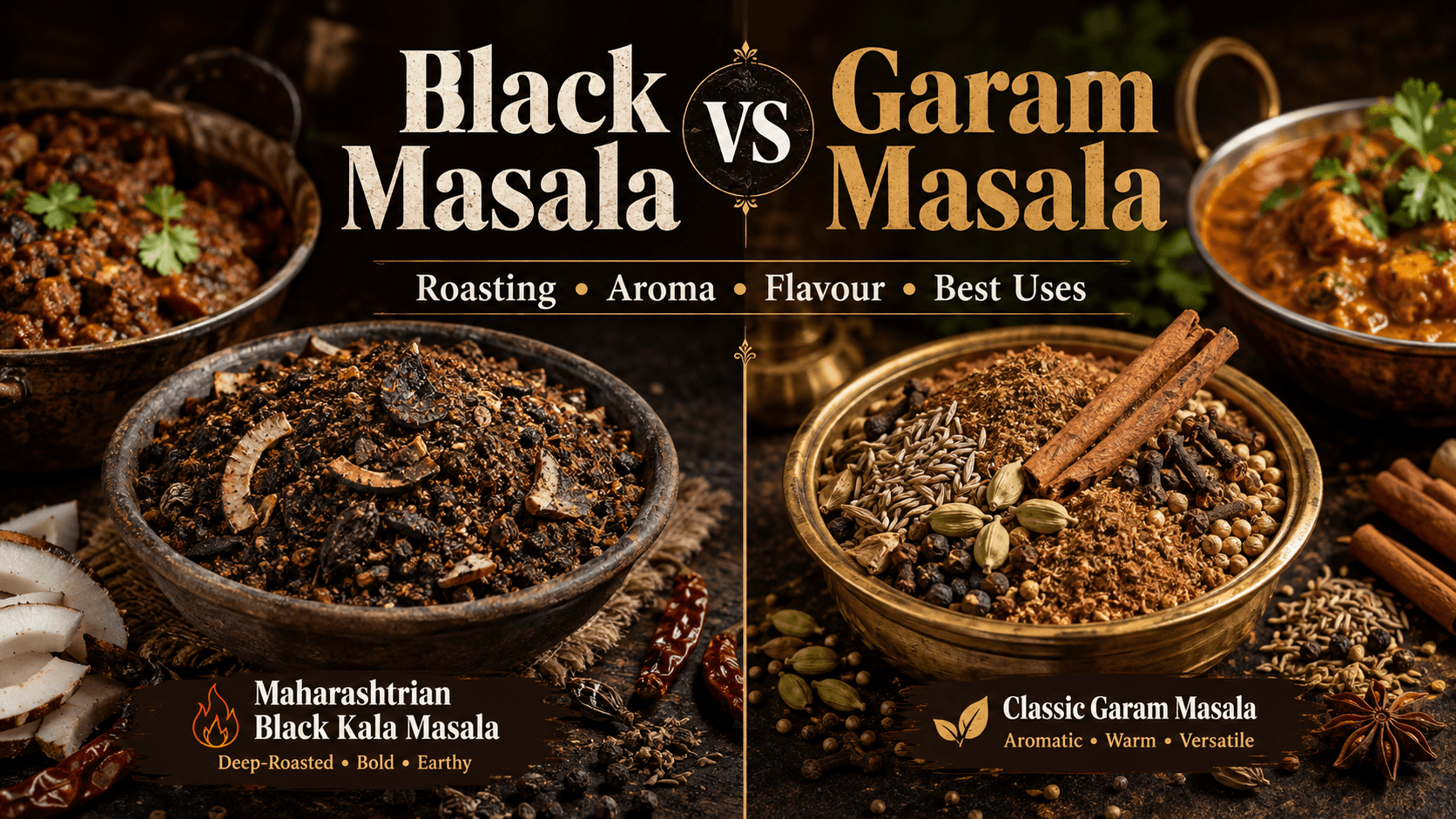
Black Masala vs Garam Masala: What’s the Difference?
Indian cooking is built around spices, but not every spice blend serves the same purpose. Two masalas that often create confusion are Black Masala and Garam Masala.
Both can add depth, aroma and complexity to curries, vegetables and gravies, yet they are noticeably different in flavour, preparation and regional identity.
Black Masala, commonly known as Kala Masala in Maharashtra, is generally a deeply roasted regional spice blend. It often develops its dark colour from roasting spices—and in many traditional recipes, ingredients such as dry coconut—until they become deep brown.
Garam Masala, on the other hand, is a widely used aromatic Indian spice blend built around warming whole spices such as cinnamon, cardamom, cloves, cumin and black pepper.
So, can Black Masala replace Garam Masala? Which is better for Maharashtrian cooking? And when should you use each one?
Here is a complete guide to Black Masala vs Garam Masala.
What Is Black Masala?
Black Masala, or Maharashtrian Kala Masala, is a traditional spice blend known for its dark colour, roasted aroma and rich, earthy taste.
There is no single universal recipe. Ingredients and proportions may change according to district, household and family tradition.
Common ingredients can include:
Coriander seeds
Cumin
Cinnamon
Cloves
Black pepper
Bay leaf
Sesame seeds
Dry coconut
Shah jeera
Stone flower or Dagad Phool
Star anise
Chilli
Other regional spices
The important characteristic is deep roasting.
Spices and coconut may be roasted separately until they develop intense colour and aroma, then cooled and ground together.
This gives Black Masala a flavour that can be:
Earthy
Toasted
Nutty
Smoky
Deeply aromatic
Slightly spicy
It is especially suited to rustic Maharashtrian gravies and dishes where the masala itself forms an important part of the flavour base.
What Is Garam Masala?
Garam Masala is one of the most recognised Indian spice blends.
The word “garam” refers to warming spices rather than simply chilli heat.
A typical Garam Masala may contain:
Cinnamon
Green cardamom
Black cardamom
Cloves
Black pepper
Cumin
Coriander
Shah jeera
Bay leaf
Mace
Nutmeg
Star anise
Recipes vary widely across India.
Some Garam Masalas are strongly cardamom-forward, while others contain more coriander or cumin. Certain regional varieties may also contain chilli or additional spices.
Compared with Kala Masala, Garam Masala is generally valued more for its fragrance and warming spice character than for roasted coconut flavour.
It can be used in:
Paneer gravies
Dal
Mixed vegetables
Chicken curry
Mutton curry
Biryani
Pulao
Chole
Rajma
Kofta
Soups and gravies
It is one of the most versatile spice blends in an Indian kitchen.
Black Masala vs Garam Masala: Quick Comparison
Feature | Black / Kala Masala | Garam Masala |
|---|---|---|
Regional identity | Strongly associated with Maharashtra | Used throughout India |
Colour | Dark brown to nearly black | Brown |
Main character | Deep, roasted and earthy | Warm, aromatic and fragrant |
Roasting | Usually stronger/deeper | Moderate roasting |
Coconut | Often used in Maharashtrian versions | Usually absent |
Flavour | Rustic, nutty, intense | Warm, fragrant, complex |
Typical use | Maharashtrian curries, usal, misal, vegetables | Curries, dal, biryani, paneer, meat |
When added | Often cooked into the gravy | Frequently added during or near the final stage |
Quantity | Usually dish-dependent | Often used in smaller quantities |
Best suited to | Regional Maharashtrian dishes | Broad Indian cooking |
1. The Biggest Difference Is the Roasting
The most important difference between Kala Masala and Garam Masala is often the roasting technique.
In Black Masala, ingredients are generally roasted more deeply.
Dry coconut, coriander seeds, sesame and whole spices may be roasted until they develop dark colour and intense flavour.
This roasting creates the characteristic:
Deep colour
Toasted aroma
Nutty flavour
Rich gravy base
Garam Masala ingredients are normally roasted enough to release their aroma but are not necessarily taken to the same dark stage.
Its purpose is usually to preserve the fragrant character of cinnamon, cardamom, pepper, cloves and similar spices.
Therefore:
Kala Masala = deeper roasted flavour
Garam Masala = stronger aromatic warmth
2. Black Masala Has a Strong Maharashtrian Identity
Kala Masala is closely connected with Maharashtrian household cooking.
Different regions can have their own versions.
You may find Black Masala used in dishes such as:
Bharli Vangi
Usal
Matki curry
Misal
Kala Rassa
Mutton curry
Chicken curry
Mixed vegetables
Dal preparations
Regional gravies
The flavour works especially well with jowar bhakri, bajra bhakri, rice and traditional village-style meals.
This makes Maharashtrian Black Masala more than a general seasoning. It represents a particular regional cooking style.
3. Garam Masala Is More Universal
Garam Masala does not belong to only one state.
Versions are found across North, Central and Western India and increasingly throughout the country.
Its broad flavour profile makes it useful in dishes such as:
Paneer Butter Masala
Dal Tadka
Rajma
Chole
Vegetable curry
Chicken Masala
Mutton curry
Biryani
Pulao
Kofta curry
If someone wants one general-purpose aromatic masala for everyday Indian cooking, Garam Masala is often the more versatile choice.
4. Black Masala Often Contains Coconut
One notable characteristic of many Maharashtrian Black Masala recipes is dry coconut.
Roasted coconut adds:
Nutty flavour
Body
Richness
Darker colour
It works particularly well in Maharashtra’s traditional curries.
Garam Masala generally focuses more heavily on whole aromatic spices and usually does not rely on roasted coconut.
However, recipes are not standardised, so always check the ingredient list of the specific product you are buying.
5. Their Aromas Are Different
Open a container of quality Garam Masala and you are likely to notice strong notes of:
Cardamom
Cinnamon
Cloves
Black pepper
The aroma is sharp, warm and fragrant.
Black Masala tends to smell:
Roasted
Earthy
Nutty
Deep
Slightly smoky
This difference becomes important when selecting a masala according to the dish.
6. They Are Often Added at Different Stages
Black Masala is frequently cooked into the dish so that its roasted flavours combine with onion, garlic, tomato, coconut, vegetables or meat.
For example:
Onion → Garlic → Black Masala → Main ingredient → Water → Slow cooking
Garam Masala can also be used during cooking, but many recipes add it towards the later stages.
This helps maintain its aromatic fragrance.
For example:
Prepare curry → Cook main ingredients → Add Garam Masala → Simmer briefly → Garnish
These are general techniques rather than strict rules. Different recipes use the blends differently.
Which Dishes Are Best with Black Masala?
Bharli Vangi
Stuffed brinjal benefits from the earthy character of roasted spices, peanuts, sesame and coconut.
Black Masala can create a deeper Maharashtrian flavour.
Misal and Usal
Sprouted beans such as matki work well with strong roasted masalas.
The blend contributes body and colour to the gravy.
Maharashtrian Mutton Curry
Kala Masala pairs naturally with onion, garlic, coconut and slow-cooked meat.
It is particularly suitable for rustic Maharashtrian mutton preparations.
Village-Style Chicken Curry
For chicken cooked with roasted onion, coconut and traditional spices, Black Masala can provide a distinctly regional taste.
Dal and Amti
A small amount can deepen certain lentil-based preparations, depending on the recipe.
Mixed Vegetables
Potato, brinjal, beans and legumes can all work well with Maharashtrian Kala Masala.
Which Dishes Are Best with Garam Masala?
Paneer Gravies
Garam Masala adds aromatic depth to tomato- and onion-based paneer preparations.
Dal
A small amount near the end of cooking can improve the aroma of dal.
Chole and Rajma
These rich pulse dishes work well with the warming character of Garam Masala.
Chicken Curry
Garam Masala can enhance both light and rich chicken gravies.
Biryani and Pulao
Its aromatic whole-spice profile works naturally with rice preparations.
Vegetable Curry
A small amount can add flavour to everyday mixed vegetables without creating the stronger roasted taste associated with Kala Masala.
Can Black Masala Replace Garam Masala?
Technically, you can experiment with substitution, but the result will not taste the same.
If a recipe asks for Garam Masala and you substitute Black Masala:
The colour may become darker.
The flavour may become more roasted.
Maharashtrian character may become stronger.
Coconut or sesame notes may become noticeable.
If you replace Black Masala with Garam Masala:
The dish may become more aromatic.
It may lose its earthy roasted flavour.
The colour may remain lighter.
The authentic Maharashtrian character may be reduced.
Therefore, for traditional recipes, it is generally better to use the masala specified.
Can You Use Black Masala and Garam Masala Together?
Yes.
In some dishes, both can work well when used carefully.
For example, Black Masala may provide the main roasted flavour during cooking, while a small amount of Garam Masala can be added near the end for aroma.
This approach may work for:
Mutton curry
Chicken curry
Rich vegetable gravy
Certain pulaos
Regional fusion dishes
However, using too much of both can overpower the main ingredients.
Start with small amounts and adjust according to taste.
Black Masala vs Goda Masala: Are They the Same?
This is another common source of confusion.
In some households and markets, the terms Kala Masala and Goda Masala may overlap. In others, they refer to different spice blends.
Goda Masala is typically an aromatic Maharashtrian masala associated with dishes such as:
Amti
Masale Bhaat
Bharli Vangi
Usal
Vegetable preparations
It can contain coconut, sesame, coriander and warming spices.
Kala Masala may be roasted more intensely, producing a darker colour and stronger flavour.
Because recipes vary greatly by family and region, it is better to judge the product by its ingredient list and flavour profile rather than assuming the names always mean exactly the same thing.
Is Black Masala More Spicy Than Garam Masala?
Not necessarily.
Dark colour does not automatically mean more chilli.
Black Masala may appear intense because of deep roasting, while Garam Masala may taste warm because of pepper, cloves, cinnamon and cardamom.
Actual chilli heat depends on:
Type of chilli used
Quantity
Recipe
Regional preference
Always check the specific blend.
Which Masala Is Better?
Neither is universally better.
Choose Black Masala when you want:
Authentic Maharashtrian taste
Deep roasted flavour
Rustic gravies
Traditional vegetables
Misal or Usal
Maharashtrian chicken or mutton
Stronger regional identity
Choose Garam Masala when you want:
Broad Indian flavour
Fragrant aroma
Paneer
Dal
Biryani or Pulao
North Indian gravies
An everyday multipurpose spice blend
A well-stocked Indian kitchen can easily keep both.
How to Choose Good-Quality Masala
Whether buying Kala Masala or Garam Masala, check the product carefully.
Look for:
Clear ingredient list
Manufacturing details
Batch number
Packing date
Best-before period
Proper food-grade packaging
Storage instructions
Trusted producer
Natural spice aroma
Avoid products that smell stale, damp or unusually artificial.
Because ground spices gradually lose aroma, keep masala tightly sealed and away from heat, sunlight and moisture.
Homemade Masala vs Mass-Produced Masala
Homemade-style spice blends may offer a stronger regional identity because recipes can retain traditional roasting and blending methods.
Mass-produced masalas offer advantages such as:
Standardisation
Consistency
Wide availability
Convenient packaging
Neither category is automatically superior.
The important factors are:
Ingredient quality
Freshness
Hygiene
Roasting technique
Proper grinding
Storage
Transparent labelling
A traditional recipe still needs professional food-safety practices when it is sold commercially.
Black Masala and Garam Masala at Gawakadcha.com
Gawakadcha.com brings together traditional village-made and homemade-style spice blends from regional producers.
Customers looking for different cooking styles can explore both:
Homemade Black Masala / Maharashtrian Kala Masala
Ideal for deep, roasted Maharashtrian curries, vegetables, Misal and traditional regional dishes.
Homemade Garam Masala
Suitable for everyday Indian curries, gravies, paneer, dal, rice dishes and other aromatic preparations.
Keeping both allows home cooks to choose the spice profile according to the recipe rather than using one generic masala for every dish.
Frequently Asked Questions
What is the main difference between Black Masala and Garam Masala?
Black Masala is generally a deeply roasted Maharashtrian spice blend with an earthy, robust flavour. Garam Masala is a fragrant warming spice blend used widely across Indian cuisine.
Is Black Masala the same as Kala Masala?
Yes, Black Masala commonly refers to Maharashtrian Kala Masala.
Is Kala Masala the same as Garam Masala?
No. Their ingredients may overlap, but roasting style, flavour and typical culinary uses differ.
What is Black Masala used for?
It is commonly used in Maharashtrian curries, Bharli Vangi, Usal, Misal, mutton, chicken and traditional vegetable preparations.
What is Garam Masala used for?
It is used in dal, paneer, chicken, mutton, biryani, pulao, chole, rajma and many Indian gravies.
Can I substitute Garam Masala for Black Masala?
You can, but the final flavour will be different and may lose some of its authentic Maharashtrian character.
Can I use both masalas together?
Yes. Black Masala can provide a roasted base while a small amount of Garam Masala can add fragrance near the end.
Is Black Masala hotter than Garam Masala?
Not necessarily. Spice heat depends on the specific recipe and chilli content.
Which masala is best for Maharashtrian food?
For many traditional Maharashtrian curries and vegetables, Kala or Black Masala provides a more authentic regional flavour.
Where can I buy Maharashtrian Black Masala online?
Authentic Black Masala and other regional spice blends can be explored through trusted platforms such as Gawakadcha.com.
Conclusion
Although Black Masala and Garam Masala contain several similar spices, they create very different culinary experiences.
Black Masala is about depth. Its deeply roasted ingredients create an earthy, rustic character strongly associated with Maharashtrian cooking.
Garam Masala is about aroma. Its warming spices bring fragrance and complexity to a broad range of Indian dishes.
Instead of asking which masala is universally better, ask which one suits the dish you are preparing.
For Bharli Vangi, Misal, Usal or a traditional Maharashtrian curry, Black Masala may be the better choice.
For Paneer, Dal, Biryani, Chole or an everyday Indian gravy, Garam Masala may fit more naturally.
Understanding the difference allows you to use each masala for what it does best—and that is one of the secrets to bringing authentic regional flavour into everyday cooking.