
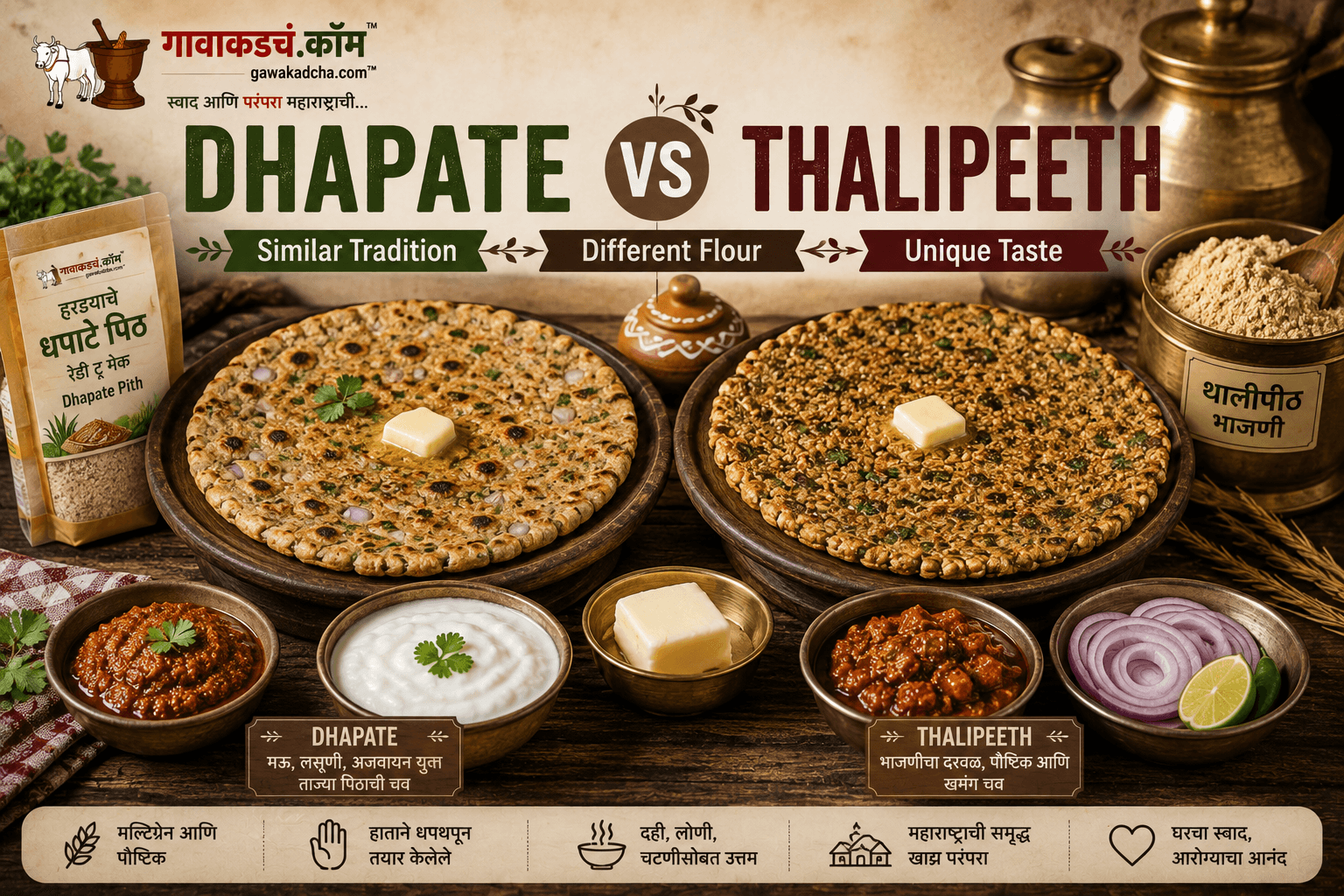
Dhapate vs Thalipeeth: What’s the Difference? A Complete Maharashtrian Food Guide
At first glance, Dhapate and Thalipeeth look almost identical.
Both are savoury Maharashtrian flatbreads. Both can contain multiple grains and pulses. Both are usually patted by hand rather than rolled like an ordinary Chapati. And both taste excellent with curd, butter, pickle, Thecha or Shenga Chutney.
Yet traditional versions are not always the same.
The biggest difference generally lies in the flour preparation.
Traditional Thalipeeth is commonly made from Bhajani—a flour prepared by roasting different grains, pulses and spices before grinding them. Dhapate is often prepared by directly mixing unroasted flours with fresh ingredients and spices.
This difference gives the two foods slightly different aromas, textures and flavour profiles.
However, Maharashtrian recipes vary considerably between regions and households, and in some places the names Dhapate and Thalipeeth may even overlap.
So what really separates them?
Let us explore Dhapate vs Thalipeeth, including their ingredients, preparation, taste, nutrition, serving combinations and cultural importance.
What Is Dhapate?
Dhapate is a savoury Maharashtrian multigrain flatbread traditionally prepared by combining different flours with spices and fresh ingredients.
Common flours may include:
Jowar flour
Wheat flour
Besan or gram flour
Bajra flour
Other grain or pulse flours
Fresh ingredients may include:
Onion
Garlic
Green chilli
Coriander
Ajwain
Cumin
Turmeric
Red chilli
The dough is usually soft and cannot always be rolled like wheat Chapati.
Instead, it is patted or pressed by hand into a flat disc and then cooked on a hot tawa.
One traditional explanation for the name connects Dhapate with the action of patting or pressing the dough into shape. Several Maharashtrian food sources also distinguish Dhapate from Thalipeeth by noting that Dhapate commonly uses mixed raw flours rather than roasted Bhajani.
What Is Thalipeeth?
Thalipeeth is one of Maharashtra’s best-known traditional multigrain flatbreads.
The key ingredient in the traditional version is Thalipeeth Bhajani.
Bhajani is prepared by roasting ingredients such as:
Jowar
Bajra
Wheat
Rice
Chana Dal
Urad Dal
Moong
Coriander seeds
Cumin
The roasted ingredients are then ground together.
Maharashtra Tourism describes Thalipeeth as a traditional preparation made from multiple roasted grains including gram, Bajra, wheat and Jowar, generally enjoyed with butter or curd.
Fresh onion, coriander, chilli and spices are added to the Bhajani when preparing the dough.
Like Dhapate, Thalipeeth is usually flattened by hand and cooked on a tawa.
Dhapate vs Thalipeeth: Quick Comparison
Feature | Dhapate | Thalipeeth |
|---|---|---|
Main flour style | Often mixed unroasted flours | Traditionally roasted Bhajani |
Grains | Jowar, wheat and others | Jowar, Bajra, wheat, rice etc. |
Pulses | Besan, Harbhara, Moong may be used | Several roasted pulses may be included |
Flavour | Fresh, rustic, spicy | Toasted, nutty, aromatic |
Garlic | Common in many recipes | Recipe-dependent |
Ajwain | Frequently used | May or may not be used |
Texture | Can be soft, thick or crisp | Usually hearty with roasted flavour |
Preparation | Mix flours directly | Bhajani often prepared beforehand |
Shaping | Patted by hand | Patted by hand |
Popular serving | Curd, chutney, pickle | Butter, curd, Thecha, pickle |
The exact recipe changes significantly by household, so this table represents the traditional broad distinction rather than a rigid rule.
1. The Biggest Difference: Bhajani
If you remember only one difference, remember this:
Thalipeeth traditionally uses roasted Bhajani.
The grains, pulses and spices are roasted before grinding.
This creates a distinctive:
Roasted • Nutty • Deep • Aromatic
flavour.
Dhapate can be simpler.
Different flours may be taken directly from the kitchen, mixed together and turned into dough.
This makes Dhapate particularly practical when you do not already have Bhajani prepared.
A simplified way to think about it is:
Thalipeeth = Roasted Multigrain Bhajani
Dhapate = Mixed Multigrain Flour + Fresh Spices
Traditional recipes can differ, but this is one of the most commonly cited distinctions.
2. Their Taste Is Different
Roasting changes flavour significantly.
Because Thalipeeth Bhajani uses roasted grains and pulses, the final flatbread can have a:
Toasted aroma
Nutty character
Deeper grain flavour
Dhapate often highlights:
Jowar
Garlic
Ajwain
Onion
Fresh coriander
Chilli
more directly.
As a result, Dhapate can taste slightly fresher and more rustic, while traditional Thalipeeth may taste more roasted and complex.
Neither is better.
They simply offer different versions of Maharashtra’s multigrain flatbread tradition.
3. Dhapate Can Be Easier to Prepare Quickly
Preparing traditional Bhajani from scratch requires several steps:
Select grains and pulses.
Clean them.
Roast them separately.
Cool completely.
Grind everything together.
Store the flour correctly.
Dhapate can often skip much of this preparation.
If the required flours are already available, you can mix them with vegetables and spices and prepare the dough immediately.
This is one reason Dhapate fits particularly well into modern households.
Ready-to-make Dhapate Pith makes the process even simpler.
4. Thalipeeth Has a Strong Bhajani Tradition
Bhajani itself is an important part of Maharashtrian food culture.
Families often have their own ratios of:
Jowar
Bajra
Rice
Wheat
Gram
Urad
Other pulses
Some recipes may contain more Jowar, while others use more pulses.
That household-specific Bhajani can make one family’s Thalipeeth taste noticeably different from another’s.
This is one reason traditional regional food is difficult to completely standardise.
The recipe is often part of family identity.
5. Both Are Multigrain Foods
Dhapate and Thalipeeth share one major strength: grain diversity.
Instead of depending entirely on one flour, they can combine cereals, millets and pulses.
Maharashtra Tourism specifically describes traditional Thalipeeth as a multigrain preparation containing ingredients such as Jowar, Bajra, wheat and gram.
Similarly, Dhapate may contain combinations of:
Jowar
Wheat
Harbhara
Moong
Bajra
The exact nutritional value depends entirely on the recipe and serving size.
Therefore, “multigrain” should not automatically be interpreted as a guarantee that the food is healthier than every alternative.
6. Fresh Ingredients Matter More in Dhapate
Many Dhapate recipes use bold fresh ingredients such as:
Onion
Garlic
Coriander
Green chilli
Ajwain
Garlic and Ajwain can give Dhapate its characteristic rustic aroma.
Thalipeeth also frequently contains onion, coriander and chilli, but the roasted Bhajani remains one of its strongest flavour components.
This makes Dhapate particularly suited to people who enjoy stronger fresh-spice flavours.
7. Both Are Traditionally Patted by Hand
Neither food is usually rolled exactly like a wheat Chapati.
The dough is often pressed using the fingers and palm.
Traditionally, cooks may flatten it on:
A damp cloth
Banana leaf
Plastic sheet
Directly on a cooled tawa
before transferring or cooking it.
This hand-patting method also explains why these foods have a rustic, uneven appearance.
The irregular shape is part of their traditional character—not a defect.
Which Tastes Better: Dhapate or Thalipeeth?
This depends entirely on preference.
Choose Dhapate if you enjoy:
Jowar flavour
Garlic
Ajwain
Fresh herbs
Rustic village-style taste
Quick flour preparation
Choose Thalipeeth if you prefer:
Roasted grain flavour
Nutty aroma
Bhajani
Deep multigrain character
Traditional butter-and-curd combinations
The easiest answer is to try both.
Best Foods to Eat with Dhapate
Dhapate works especially well with:
Shenga Chutney
The roasted peanut, garlic and chilli flavour of Maharashtrian Shenga Chutney complements Dhapate naturally.
Plain Curd
Curd balances the spice and provides a cooling contrast.
Homemade Pickle
Lemon, mango or chilli pickle can add tanginess.
White Butter
A small amount of butter on hot Dhapate creates a rich traditional combination.
Thecha
For people who enjoy intense chilli and garlic flavour.
A particularly good serving combination is:
Hot Dhapate + Curd + Shenga Chutney + Onion
Best Foods to Eat with Thalipeeth
Traditional Thalipeeth works beautifully with:
White butter
Curd
Thecha
Pickle
Chutney
Maharashtra Tourism specifically notes butter and curd as familiar accompaniments.
A classic plate is:
Hot Thalipeeth + White Butter + Curd + Pickle
Dhapate vs Thalipeeth: Which Is Healthier?
There is no universal winner.
Both can form part of a balanced meal.
The nutritional value depends on:
Grain ratios
Pulse quantity
Vegetables added
Oil used
Portion size
Accompaniments
For example, a multigrain flatbread prepared with moderate oil and served with curd and vegetables may form a very different meal from one cooked in excessive oil and topped with large amounts of butter.
Rather than asking only:
“Which is healthier?”
ask:
“How is it prepared, what ingredients are used and what am I eating with it?”
Is Dhapate Gluten-Free?
Not necessarily.
Some Dhapate versions use wheat.
For example, Gawakadcha’s current Hurdyache Dhapate Pith contains Hurda, Jowar, Wheat, Harbhara, Moong Dal, Ova and Jeera. Therefore, that particular blend is not gluten-free.
People who medically need to avoid gluten should always read the complete ingredient list.
Is Thalipeeth Gluten-Free?
It depends on the Bhajani.
Traditional Thalipeeth may contain wheat, but wheat-free versions can also be made using millet, rice and pulse flours.
Even if the individual grains are gluten-free, people with coeliac disease need to consider cross-contamination during grinding and packaging.
What Is Hurdyache Dhapate Pith?
Hurda refers to tender young Jowar traditionally enjoyed in Maharashtra during the winter season.
Gawakadcha currently offers a ready-to-make Hurdyache Dhapate Pith manufactured in Jalna district by Dnyaneshwari Mahila Gruh Udyog.
Its declared ingredients are:
Hurda • Jowar • Wheat • Harbhara • Moong Dal • Ova • Jeera
The mixture is designed to make traditional Dhapate more convenient for modern households—customers add water, prepare the dough, shape the Dhapate and cook them on a pan.
This is a good example of how traditional food can adapt to modern lifestyles without requiring consumers to prepare every flour separately.
Dhapate, Thalipeeth and the Revival of Traditional Maharashtrian Food
Both foods represent a larger trend taking place in Indian kitchens.
Consumers are rediscovering:
Jowar
Bajra
Ragi
Traditional flour blends
Regional breakfasts
Village-style recipes
At the same time, modern families want convenience.
This creates opportunities for:
Ready flour mixes
Traditional Bhajani
Regional chutneys
Homemade masalas
Pickles
Traditional recipes do not necessarily need to disappear because lifestyles have changed.
They can evolve into convenient formats while retaining their basic identity.
Frequently Asked Questions
Are Dhapate and Thalipeeth the same?
They are closely related Maharashtrian multigrain flatbreads, but traditionally they are not always identical. Thalipeeth commonly uses roasted Bhajani, while Dhapate often uses directly mixed unroasted flours. Regional naming and recipes may overlap.
What is the main difference between Dhapate and Thalipeeth?
The most common distinction is flour preparation: Thalipeeth traditionally uses roasted Bhajani; Dhapate often uses mixed raw flours.
What is Thalipeeth Bhajani?
Bhajani is a flour blend made by roasting grains, pulses and sometimes spices before grinding them together.
What is Dhapate made from?
Recipes vary, but Dhapate can include Jowar, wheat, Besan or other pulse/grain flours with onion, garlic, chilli, coriander and Ajwain.
Which is better for breakfast?
Both can make filling Maharashtrian breakfast options depending on ingredients, portion size and accompaniments.
Can Dhapate be eaten with Shenga Chutney?
Yes. Dhapate, curd and Shenga Chutney make a particularly good Maharashtrian-style combination.
Where can I buy Dhapate Pith online?
Gawakadcha.com currently offers Hurdyache Dhapate Pith in ready-to-make form.
Conclusion
Dhapate and Thalipeeth are close cousins—but they are not always the same dish.
Both belong to Maharashtra’s rich multigrain flatbread tradition.
The biggest traditional difference is the flour:
Dhapate → Often made by mixing unroasted flours directly
Thalipeeth → Traditionally made using roasted multigrain Bhajani
That difference changes the flavour.
Dhapate can taste fresh, spicy, garlicky and rustic.
Thalipeeth brings a deeper roasted and nutty character from Bhajani.
But Maharashtrian food traditions differ from village to village and household to household, so no single recipe should be treated as the only “correct” version.
What matters most is that both dishes continue to keep Jowar, Bajra, pulses, traditional cooking methods and Maharashtrian food culture relevant in modern kitchens.
Dhapate offers rustic simplicity. Thalipeeth offers roasted Bhajani depth. Both bring Maharashtra to the plate.