
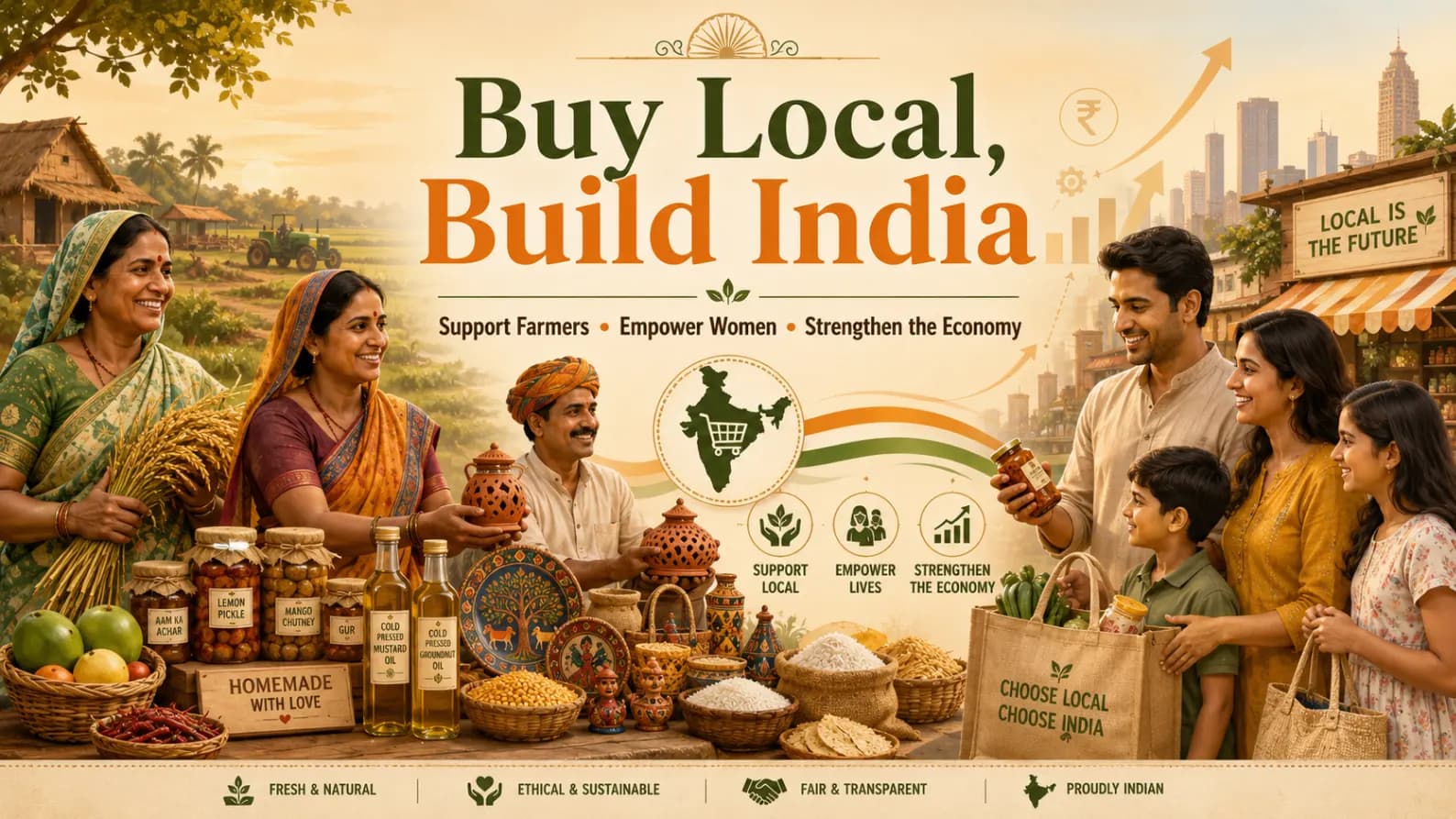
Every purchase is an economic decision.
When consumers buy a locally made product, their money does more than pay for an item. It may support a farmer who supplied the raw material, a rural woman who prepared the product, a local worker who packed it, a small transport operator who moved it and an Indian business that marketed it.
This is why phrases such as “Vocal for Local,” “Made in India,” “support local businesses,” and “buy Indian products” have become increasingly important.
India’s villages, towns and small cities are home to countless farmers, artisans, women’s self-help groups, food producers and micro-enterprises. They manufacture traditional foods, cold-pressed oils, spices, pickles, papad, millet products, handicrafts, clothing, household goods and many other everyday products.
However, these producers often compete with large, highly marketed brands that have greater access to technology, advertising, logistics and retail networks.
By consciously choosing reliable local products, consumers can help strengthen small enterprises, encourage employment, protect regional skills and build a more resilient Indian economy.
What Does Buying Local Products Mean?
Buying local products means purchasing goods made, grown, processed or crafted by producers within your region or country.
A local product may be:
- Grown by an Indian farmer
- Prepared by a rural woman entrepreneur
- Manufactured by a micro or small enterprise
- Produced by a women’s self-help group
- Handmade by an artisan
- Processed by a Farmer Producer Organisation
- Sold by a neighbourhood business
- Developed by an Indian startup
- Made using regional ingredients and traditional knowledge
Buying local does not always mean purchasing only from the shop nearest to your home.
A product prepared in a village in Maharashtra and ordered online by a customer in Bengaluru, Delhi or Kolkata still connects an Indian producer with an Indian household.
Digital marketplaces have expanded the meaning of “local” by allowing regional products to reach customers throughout the country.
Why Are Local Products Important for India?
India has a large and diverse economic structure. Alongside major corporations, millions of livelihoods depend on farms, family-run businesses, rural enterprises, small processing units, artisans and local service providers.
These businesses contribute to the economy by:
- Creating employment
- Processing agricultural produce
- Supporting local supply chains
- Generating household income
- Encouraging entrepreneurship
- Preserving regional skills
- Meeting local consumer needs
- Bringing economic activity to smaller towns and villages
When local businesses grow, economic opportunities are distributed beyond major industrial centres.
This is especially important for rural India, where stable non-farm and value-added income opportunities can strengthen household resilience.
12 Ways Buying Local Products Helps India’s Economy
1. It Keeps More Economic Activity Within India
When you purchase an Indian-made product, a greater share of the transaction may remain within the domestic economy.
The seller uses that income to pay for:
- Raw materials
- Employee wages
- Packaging
- Transportation
- Rent
- Electricity
- Equipment
- Digital services
- Taxes
- Business expansion
The people and businesses receiving these payments may then spend their income on other goods and services.
For example, when a customer purchases homemade masala from a rural women’s enterprise, the transaction may support spice farmers, grinders, packaging suppliers, delivery workers and the women who prepared the product.
One purchase can therefore create economic activity across several connected businesses.
2. It Supports Micro and Small Enterprises
Micro and small businesses are found in almost every part of India.
They include:
- Food-processing units
- Flour mills
- Oil extraction units
- Printing and packaging businesses
- Tailoring units
- Handicraft workshops
- Local retailers
- Transport services
- Digital startups
- Home-based enterprises
These businesses may not have the advertising budgets or nationwide distribution networks of large companies.
Regular customer demand gives them the confidence to improve quality, purchase equipment, hire workers and enter new markets.
Supporting local businesses does not mean ignoring quality. It means giving capable Indian enterprises a fair opportunity when their products offer suitable quality, value and reliability.
3. It Creates Local Employment
A growing local business often requires more people.
A food producer may need workers for:
- Cleaning ingredients
- Sorting grains
- Grinding spices
- Preparing recipes
- Packing products
- Applying labels
- Managing inventory
- Processing orders
- Handling customer support
- Coordinating delivery
An artisan may need help with raw-material preparation, finishing, packing and sales.
Even a small increase in orders can create part-time, seasonal or permanent employment.
Local employment is particularly valuable because people may be able to work closer to their homes instead of migrating only because suitable work is unavailable nearby.
4. It Strengthens Rural Livelihoods
Rural households often depend on agriculture, but farming income can be seasonal and affected by weather, prices and input costs.
Local product enterprises create opportunities beyond selling raw agricultural produce.
For example:
- Groundnuts can become cold-pressed groundnut oil.
- Millets can become flour mixes or traditional snacks.
- Mangoes and lemons can become pickles.
- Spices can become regional masala blends.
- Pulses can be cleaned, graded and packaged.
- Bamboo can become household baskets and handicrafts.
This process is called value addition.
Instead of selling only a raw ingredient, rural producers can earn through processing, packaging, branding and direct selling.
Buying such products helps increase demand for rural value-added enterprises.
5. It Encourages Women’s Economic Participation
Women play an important role in rural production, agriculture, food processing and household enterprises.
Many women possess valuable skills in:
- Pickle making
- Papad preparation
- Spice blending
- Traditional snacks
- Millet products
- Stitching
- Handicrafts
- Agarbatti making
- Dairy processing
- Natural household products
However, these skills may remain limited to unpaid household work or small local sales.
When customers purchase products made by women entrepreneurs and self-help groups, traditional skills gain commercial value.
A stable source of income may help women:
- Contribute to household finances
- Build financial confidence
- Participate in business decisions
- Invest in education and equipment
- Create employment for other women
- Develop independent enterprise identities
Supporting women-led local businesses creates both economic and social value.
6. It Helps Farmers Receive Demand for Local Produce
Many local products begin with ingredients supplied by farmers.
Traditional food enterprises may purchase:
- Jowar
- Bajra
- Ragi
- Groundnuts
- Safflower seeds
- Sunflower seeds
- Pulses
- Chillies
- Turmeric
- Coriander
- Sesame
- Fruits
- Vegetables
When customers choose products made from regional ingredients, demand can move backwards through the supply chain to the farmer.
A growing millet-snack business, for example, may require more millet flour. A growing cold-pressed oil business may require more quality oilseeds.
The benefit depends on how transparently the producer sources ingredients, but strong local supply chains can create better market opportunities for farmers.
7. It Promotes Entrepreneurship
Every successful local business encourages others to explore entrepreneurship.
A home-based producer who begins by selling ten packets of masala may eventually:
- Improve the recipe.
- Create standard pack sizes.
- Register the business.
- Develop better packaging.
- Sell through digital marketplaces.
- Hire local workers.
- Supply customers across India.
- Introduce additional products.
Consumer demand gives entrepreneurs a reason to take these steps.
Without customers, even a high-quality product cannot become a sustainable business.
By trying and recommending reliable local products, consumers help create an environment where new businesses can develop.
8. It Preserves Traditional Skills and Regional Culture
India’s local products carry knowledge developed over generations.
Traditional skills may include:
- Regional spice blending
- Pickle preservation
- Papad making
- Cold-pressed oil extraction
- Millet preparation
- Handloom weaving
- Bamboo craftsmanship
- Pottery
- Natural dyeing
- Handmade household products
These traditions survive when people continue to use and purchase the products.
When demand disappears, the next generation may have little economic reason to learn the skill.
Buying authentic regional products gives traditional knowledge a place in the modern marketplace.
It shows that cultural heritage can remain economically relevant rather than being preserved only in exhibitions or memories.
9. It Reduces Dependence on Distant Supply Chains
Long and highly concentrated supply chains may be vulnerable to:
- Transportation disruptions
- Fuel-price changes
- Import delays
- International conflicts
- Natural disasters
- Sudden shortages
- Currency fluctuations
Local production does not eliminate every risk, but a diverse domestic supplier base can improve economic resilience.
When households, retailers and institutions have access to capable Indian producers, they have more sourcing options.
A strong economy should include large industries as well as distributed networks of small manufacturers, farmers, artisans and local service providers.
10. It Encourages Product Innovation
Local businesses understand regional preferences closely.
A rural food enterprise may develop products based on:
- Local recipes
- Seasonal ingredients
- Fasting requirements
- Regional spice levels
- Millet traditions
- Customer feedback
- Convenient pack sizes
For example, a traditional Dhapate flour mix transforms a regional recipe into a convenient product for working families.
Similarly, ragi biscuits, jaggery cookies, homemade masalas and ready-to-cook traditional foods combine familiar ingredients with modern convenience.
When customers respond positively, producers are encouraged to improve and innovate without completely abandoning local identity.
11. It Expands India’s Digital Economy
E-commerce allows small producers to reach customers without opening physical shops in every city.
Through online platforms, local businesses can access:
- Digital product listings
- Online payments
- Social-media promotion
- Customer reviews
- Delivery networks
- Repeat-order systems
- Search-engine visibility
- Nationwide audiences
A village producer who once sold only within a nearby market may now receive an order from a metropolitan household.
This brings rural enterprise into India’s digital economy.
However, producers often require support with photography, packaging, catalogue creation, payments, logistics and customer communication.
Marketplaces focused on rural products can help provide this bridge.
12. It Can Increase Government Revenue and Formalisation
As small businesses grow and become organised, they may complete registrations, maintain records, use banking channels, issue invoices and comply with relevant tax and food-safety requirements.
Formalisation can help businesses gain access to:
- Bank accounts
- Business credit
- Government schemes
- Digital payments
- Larger marketplaces
- Institutional customers
- Better business records
- Expansion opportunities
It can also increase legitimate economic activity and government revenue through applicable taxes and fees.
Consumers contribute to this process when they purchase from transparent, compliant and traceable local businesses.
How Local Buying Creates a Multiplier Effect
Consider a customer who buys a packet of traditional Maharashtrian masala from a rural producer.
The customer’s payment may be divided among:
- Farmers who supplied the spices
- Women who cleaned and blended the ingredients
- A local grinding unit
- Packaging and label suppliers
- Transport providers
- The online marketplace
- Delivery partners
- The producer’s household
Each participant may spend their earnings again within the economy.
The farmer may purchase agricultural supplies. The worker may buy household goods. The packaging business may purchase new equipment. The producer may employ another person.
This repeated movement of money creates a broader economic effect than the original transaction alone.
The exact impact varies by product and supply chain, but the underlying principle remains: local purchasing can support multiple connected livelihoods.
Buying Local Products and Atmanirbhar Bharat
The idea of an Atmanirbhar Bharat, or self-reliant India, does not mean that India should avoid all international trade.
No modern economy produces every product entirely on its own.
Self-reliance means developing strong domestic capabilities so that Indian businesses can:
- Produce competitively
- Improve quality
- Innovate
- Build brands
- Generate employment
- Participate in global supply chains
- Reduce avoidable dependencies
- Export valuable Indian products
Consumers contribute by considering capable domestic producers rather than automatically assuming that imported or large-brand products are superior.
Local businesses must also earn customer trust through quality, safety, transparency and reliable service.
Self-reliance is therefore a shared responsibility between producers, consumers, platforms and policymakers.
Vocal for Local: More Than a Slogan
“Vocal for Local” becomes meaningful only when it leads to informed purchasing.
Consumers can support local enterprises by:
- Trying reliable Indian products
- Sharing honest feedback
- Recommending good businesses
- Posting genuine reviews
- Following local brands online
- Purchasing gifts from artisans
- Buying directly from producers
- Asking retailers to stock regional products
- Avoiding unreasonable bargaining with small makers
- Choosing quality over brand size alone
Being vocal does not mean making exaggerated claims.
A customer who honestly explains why a local product is useful can create more trust than a highly promotional advertisement.
Local Products vs Imported Products
The choice between local and imported products should not be based only on emotion.
Consumers should compare:
- Quality
- Safety
- Price
- Durability
- Ingredients
- Performance
- Repairability
- Producer transparency
- Environmental impact
- Availability
Imported products may be necessary or more suitable in some categories.
However, when a reliable Indian product offers comparable quality and value, choosing it can generate more direct domestic economic benefits.
The goal is not to reject global trade. The goal is to ensure that Indian producers receive a fair opportunity to compete and improve.
Are All Local Products Automatically Better?
No.
A product does not become safe, healthy or high-quality simply because it is local, rural, handmade or homemade.
Consumers should still check:
- Ingredient list
- Manufacturer or producer details
- Packaging condition
- Batch information
- Manufacturing date
- Best-before date
- Food-safety licence details
- Allergen declaration
- Storage instructions
- Customer reviews
- Return or support policy
Similarly, local businesses must not depend only on emotional marketing.
They should provide:
- Consistent product quality
- Hygienic production
- Accurate weights
- Honest descriptions
- Fair pricing
- Safe packaging
- Reliable delivery
- Responsive customer service
Sustainable local commerce is built on trust, not sympathy.
How to Identify Genuine Local Products
Check the Producer’s Location
Look for clear information about where the product was manufactured, processed or prepared.
Read the Label Carefully
The label should provide the required product, producer, quantity, date and storage details.
Understand the Ingredients
For food products, prefer transparent ingredient lists that clearly explain what the product contains.
Learn the Product Story
Reliable sellers often explain the product’s origin, regional use and production method without making unrealistic claims.
Check Reviews
Customer reviews can reveal information about quality, taste, packaging and delivery.
Buy Through a Trusted Platform
A structured marketplace can provide better product information, payment support, order tracking and customer assistance.
Avoid Unrealistic Claims
Be careful when products claim to cure diseases, guarantee weight loss or provide impossible health benefits.
Local Products That Indian Consumers Can Support
Traditional Food Products
- Homemade pickles
- Regional masalas
- Papad
- Chutneys
- Millet flour
- Ready-to-make traditional foods
- Dried foods
- Homemade snacks
Agricultural Products
- Locally grown grains
- Unpolished pulses
- Millets
- Natural sweeteners
- Regional spices
- Cold-pressed oils
Handmade Products
- Bamboo baskets
- Pottery
- Handloom products
- Traditional brooms
- Natural-fibre products
- Wooden handicrafts
- Home décor
Women-Led Products
- Papad and pickles
- Spices
- Snacks
- Textiles
- Agarbatti
- Personal-care products
- Handmade gifts
Local Services
Supporting local printers, repair technicians, photographers, consultants, transport operators and digital professionals also strengthens the community economy.
How Gawakadcha Supports the Local Economy
Gawakadcha.com connects rural producers, women entrepreneurs, farmers, artisans and small businesses with customers looking for authentic village products.
The platform brings together categories such as:
- Ready-to-make traditional foods
- Homemade masalas
- Pickles
- Papad
- Dried foods
- Cold-pressed oils
- Grains and pulses
- Millet products
- Cookies
- Fasting snacks
- Agarbatti
- Rural handicrafts
This model can help local producers overcome barriers related to:
- Digital visibility
- Product presentation
- Online ordering
- Customer reach
- Payments
- Marketing
- Logistics
- Brand recognition
For customers, it provides convenient access to regional products that may not be available in nearby supermarkets.
For producers, it creates an opportunity to sell beyond the village, district or state.
From Village Producer to Urban Customer
A simple online order may connect several parts of India’s economy.
Imagine a customer in Mumbai ordering cold-pressed groundnut oil from a rural producer.
The process may support:
- A farmer who grew the groundnuts
- Workers who cleaned and sorted them
- A local oil-extraction unit
- Bottle and label suppliers
- People responsible for packing
- The digital marketplace
- Courier and delivery workers
- The producer’s family and enterprise
The customer receives a useful product, while several participants receive economic value.
This is how digital commerce can turn local products into nationwide opportunities.
How Consumers Can Support Local Businesses Without Overspending
Supporting local does not require replacing every household product immediately.
Start with practical choices.
Replace One Product at a Time
Try a local masala, pickle, oil, grain, snack or handmade household item.
Compare Value, Not Only Price
A slightly higher-priced local product may involve smaller production batches, better raw materials or more direct livelihood support.
However, the price should still be reasonable and transparent.
Purchase According to Need
Do not buy products only because they are local. Unused products create waste and do not build meaningful demand.
Give Constructive Feedback
Tell the producer what worked and what could improve.
Recommend Reliable Products
Personal recommendations help small businesses reach new customers.
Place Repeat Orders
Consistent demand is more valuable than a one-time sympathy purchase.
Choose Local Gifts
Festival hampers, regional foods and handmade products can support multiple small producers.
The Role of Businesses and Institutions
Consumers are not the only participants in local economic development.
Companies, schools, offices, hotels, restaurants, government departments and institutions can also support local businesses.
They can source:
- Employee gifts
- Festival hampers
- Office supplies
- Food products
- Uniforms
- Handicrafts
- Catering ingredients
- Local services
Institutional orders can provide predictable demand and help small enterprises scale.
However, suppliers should be selected through fair quality, price and compliance standards.
Environmental Benefits of Local Products
Local products may sometimes travel shorter distances and use regional materials, which can reduce certain transport and packaging requirements.
Traditional products may also use:
- Seasonal ingredients
- Local grains
- Natural fibres
- Reusable materials
- Repairable designs
- Small-batch production
However, “local” does not automatically mean environmentally friendly.
The true environmental impact depends on:
- Production method
- Energy use
- Packaging
- Transport efficiency
- Product durability
- Waste generation
- Raw-material sourcing
Consumers should therefore consider both origin and production practices.
Frequently Asked Questions
How does buying local products help India’s economy?
Buying local products supports domestic businesses, employment, farmers, artisans, rural enterprises, women entrepreneurs and connected supply chains. The income earned may be spent again within the Indian economy.
What are local products?
Local products are goods grown, prepared, processed, manufactured or crafted by producers within a region or country.
Does buying local create jobs?
Growing demand can encourage local businesses to employ people for production, packaging, sales, logistics, administration and customer support.
How does buying local help farmers?
Local food and processing businesses may purchase grains, oilseeds, spices, fruits and other raw materials from farmers, creating demand for agricultural produce.
How does buying local support women?
Purchasing from women-led enterprises and self-help groups can create income, business experience, recognition and opportunities for women to expand their economic participation.
What is the meaning of Vocal for Local?
Vocal for Local encourages people to discover, use and promote reliable Indian products and businesses.
Are local products always cheaper?
Not always. Small-scale products may cost more because of lower production volumes, handmade processing, better raw materials or higher logistics costs.
Are local products always healthier?
No. Health depends on ingredients, processing, hygiene, portion size and nutritional composition—not only on whether the product is local or homemade.
Where can I buy Indian village products online?
Customers can explore regional food products, rural handicrafts and women-made products through trusted rural marketplaces such as Gawakadcha.com.
How can I support local businesses?
Buy according to your needs, leave genuine reviews, recommend reliable products, give constructive feedback and place repeat orders when satisfied.
Conclusion
Buying local products is one of the simplest ways consumers can participate in India’s economic development.
A local purchase may support farmers, rural women, artisans, workers, transport providers, packaging businesses, digital platforms and small entrepreneurs.
It can help create employment, preserve traditional knowledge, strengthen regional supply chains and bring economic opportunity to villages and smaller towns.
However, supporting local products should not mean accepting poor quality or misleading claims.
Local businesses must earn long-term trust through safe production, transparent information, fair pricing, consistent quality and reliable service.
Consumers, in turn, can look beyond famous brand names and give capable Indian producers a genuine opportunity.
When quality local products receive regular demand, they can grow from household enterprises into recognised businesses—and from village markets into nationwide brands.
Buying local is not merely about purchasing an Indian product. It is about investing in Indian skills, livelihoods, enterprise and economic resilience.