
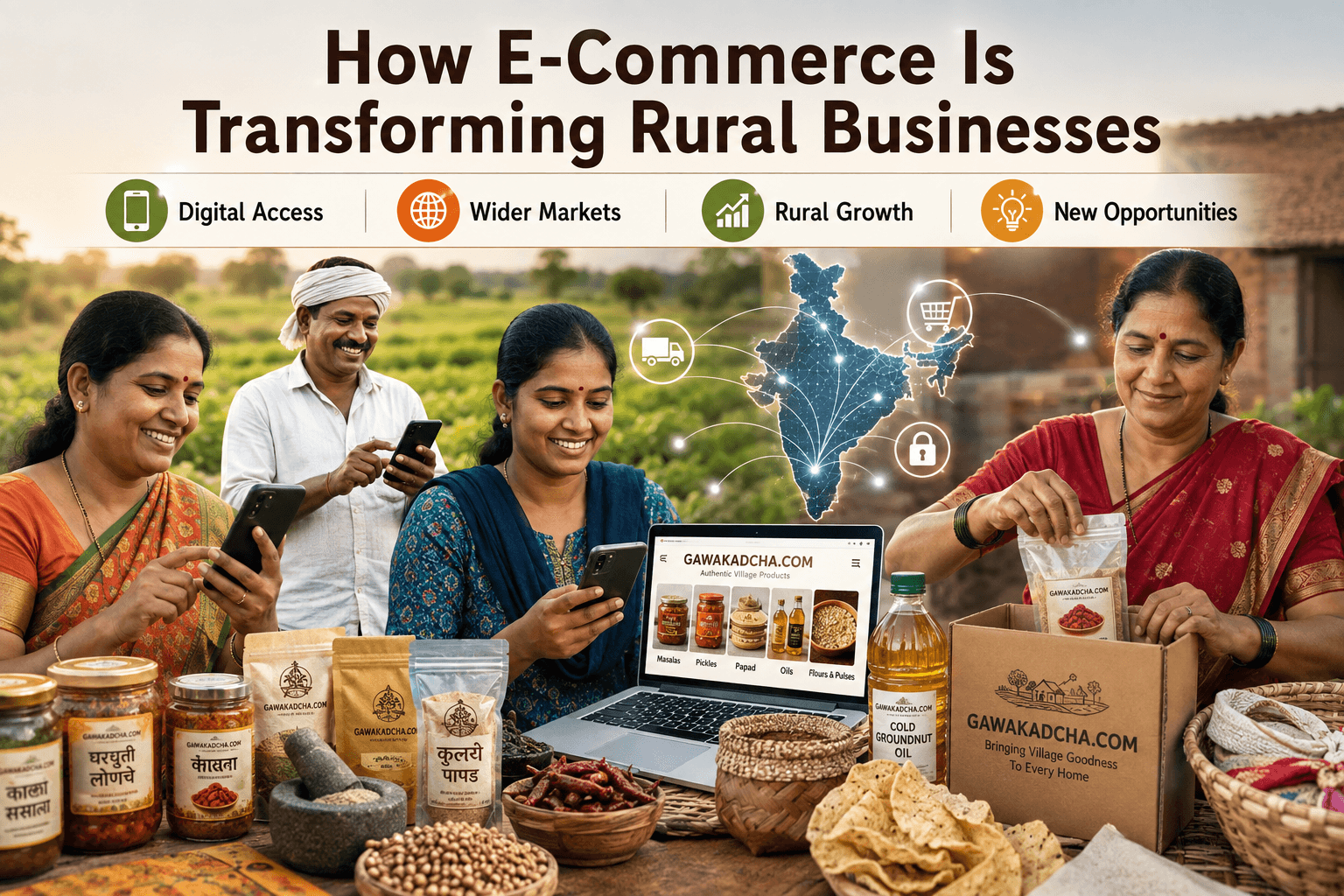
How E-Commerce Is Transforming Rural Businesses in India
India’s villages have always been centres of production, craftsmanship, agriculture and traditional knowledge. Rural families produce everything from grains, spices and cold-pressed oils to homemade pickles, papad, handicrafts, textiles and regional food products.
For decades, however, many rural businesses faced one major limitation: market access.
A skilled woman making traditional masala in a village might have customers only within a few kilometres. A farmer producing quality grains might depend on local traders. An artisan creating handmade products could struggle to reach customers in major cities.
E-commerce is changing this equation.
Digital marketplaces, smartphones, online payments, social media and nationwide logistics are helping rural entrepreneurs reach customers far beyond their local markets.
Today, a product made in a small village can be discovered by someone in Mumbai, Pune, Bengaluru, Hyderabad, Delhi or another part of India within minutes.
This transformation is creating new opportunities for rural businesses, women entrepreneurs, self-help groups, farmers, artisans and small food producers.
Let us understand how e-commerce is transforming rural businesses and why this shift matters for the future of India’s rural economy.
What Is Rural E-Commerce?
Rural e-commerce refers to the use of digital platforms to buy and sell products made, grown or processed by rural producers.
These products may include:
Homemade food products
Traditional masalas
Pickles
Papad and dried foods
Millet products
Grains and pulses
Cold-pressed oils
Handmade snacks
Handicrafts
Bamboo products
Textiles
Agarbatti
Agricultural products
Regional speciality foods
E-commerce gives rural producers access to digital tools such as:
Online product listings
Digital payments
Mobile applications
Social media marketing
Courier networks
Customer reviews
Online advertising
Inventory management
Order tracking
This allows a small rural enterprise to participate in a market that was previously difficult to access.
10 Ways E-Commerce Is Transforming Rural Businesses
1. Expanding Market Access Beyond the Village
One of the biggest advantages of e-commerce is the removal of geographical limitations.
Traditionally, many rural businesses depended on:
Weekly village markets
Local shops
Nearby towns
Small distributors
Word-of-mouth sales
This limited the number of customers a producer could reach.
E-commerce allows the same business to sell to customers across cities, districts and states.
For example, a rural woman preparing homemade Kala Masala may once have sold only within her village. Through an online marketplace, the same masala can reach customers searching for authentic Maharashtrian masala online.
This changes the business from:
Local Seller → Regional Producer → Digital Brand
2. Creating New Opportunities for Rural Women Entrepreneurs
Women play an important role in rural food production and household businesses.
Many women already possess skills in:
Pickle making
Papad preparation
Masala blending
Chutney making
Millet products
Traditional snacks
Handicrafts
Agarbatti
Food processing
The challenge is often not production—it is reaching customers.
E-commerce creates an opportunity for women to turn traditional skills into organised businesses.
Through digital platforms, women can:
Receive online orders
Build customer relationships
Accept digital payments
Sell beyond the village
Create their own brand identity
Generate independent income
This can strengthen financial confidence while giving traditional skills greater commercial value.
3. Connecting Farmers Directly with Consumers
E-commerce can also reduce the distance between farmers and customers.
Farmers traditionally depend on several layers of intermediaries before products reach consumers.
Digital platforms can create opportunities for more direct connections.
Agricultural products may include:
Jowar
Bajra
Ragi
Pulses
Groundnuts
Oilseeds
Spices
Honey
Fruits
Natural products
Direct or semi-direct selling can help producers understand customer demand and build stronger product identities.
For example:
Groundnut → Cold-Pressed Groundnut Oil
Jowar → Dhapate Pith
Pulses → Unpolished Dal
Mango → Homemade Pickle
This value-added approach can create higher business potential than selling only raw agricultural produce.
4. Helping Traditional Products Reach Modern Customers
Many traditional products disappear not because people dislike them, but because customers cannot easily find them.
Examples include:
Sandge
Kurdai
Mirgund
Traditional chutneys
Regional masalas
Millet flour mixes
Handmade papad
Village snacks
A customer living in a metropolitan city may want these products but have no nearby source.
E-commerce helps solve this problem.
Digital marketplaces make traditional products searchable.
A customer can search for:
homemade Maharashtrian food
village products online
traditional masala online
handmade papad
millet products
cold-pressed oils
and discover products that were once limited to local markets.
This creates an important connection between rural tradition and urban demand.
5. Encouraging Better Packaging and Product Presentation
Selling locally and selling online require different standards.
A product sold at a village market may need only basic packaging.
Online customers expect:
Clear labels
Professional packaging
Ingredient information
Net quantity
Manufacturing details
Best-before dates
Storage instructions
Good product photography
As rural businesses enter e-commerce, they are encouraged to improve product presentation.
This can help businesses become more competitive.
Professional packaging also improves customer confidence.
However, packaging should not replace product quality.
The ideal combination is:
Authentic Product + Safe Packaging + Transparent Information
6. Bringing Digital Payments to Rural Businesses
Digital payments have changed the way small businesses operate.
Rural businesses can now receive payments through:
UPI
QR codes
Payment gateways
Mobile banking
Digital wallets
Online marketplace payments
This reduces dependence on cash-only transactions.
Digital payments also create better transaction records.
For growing businesses, these records can help with:
Accounting
Business analysis
Banking
Financial planning
Loan applications
Tax compliance
Digital payment adoption is therefore not only about convenience. It can also encourage business formalisation.
7. Helping Rural Businesses Build Their Own Brands
Earlier, many rural producers sold products without creating a recognised brand.
For example, a woman might sell homemade masala in simple packets with no brand name.
Online selling changes this.
E-commerce encourages producers to think about:
Product name
Brand identity
Logo
Packaging design
Product description
Customer reviews
Quality consistency
Over time, a village product can develop its own identity.
This transition can look like:
Homemade Product → Local Business → Recognised Brand
Brand building creates long-term value because customers begin searching for the producer or product directly.
8. Creating Employment Within Rural Communities
As online orders increase, rural businesses may need additional workers.
A food-processing business may require people for:
Cleaning ingredients
Sorting
Grinding
Cooking
Packing
Labelling
Inventory
Dispatch
An artisan business may require workers for:
Raw-material preparation
Production
Finishing
Quality checking
Packing
This means one successful rural e-commerce business can create employment beyond the original entrepreneur.
Over time, multiple rural businesses can create a small local economic ecosystem.
9. Giving Rural Businesses Access to Customer Feedback
Traditional offline businesses may have limited information about what customers actually think.
E-commerce provides:
Ratings
Reviews
Comments
Repeat-order data
Customer questions
This information can help producers understand:
Which products customers like
Which packaging needs improvement
What pack sizes are preferred
Whether taste is consistent
What new products customers want
Customer feedback can improve product quality.
For example, customers may ask for:
Smaller pack sizes
Less spicy masala
Better packaging
Combo packs
Festival products
A rural business can use this information to improve and innovate.
10. Encouraging Rural Entrepreneurship
Perhaps the biggest long-term impact of e-commerce is confidence.
When one person in a village successfully sells products online, others begin to see new possibilities.
A small enterprise may begin with:
One Product
Then expand to:
Multiple Products
Then:
Regional Brand
Eventually:
Nationwide Customer Base
This success can inspire:
Rural women
Young entrepreneurs
Farmers
Artisans
Self-help groups
to explore new business opportunities.
This creates a culture of entrepreneurship rather than dependence only on traditional employment.
Role of Smartphones in Rural E-Commerce
Smartphones are one of the most important tools driving rural digital commerce.
A smartphone can help an entrepreneur:
Take product photos
Receive WhatsApp enquiries
Check orders
Accept payments
Upload products
Promote reels
Respond to customers
Track shipments
Earlier, building a business required expensive infrastructure.
Today, a smartphone can become a small business management tool.
This reduces the entry barrier for rural entrepreneurs.
Role of Social Media
Social media has become another powerful marketing channel.
Platforms such as Instagram, Facebook, WhatsApp and YouTube allow rural products to reach audiences quickly.
A simple video showing:
Papad making
Traditional masala grinding
Pickle preparation
Cold-pressed oil extraction
Millet flour production
can help customers understand the product story.
People increasingly want to know:
Who made this product?
Where was it made?
How is it prepared?
This gives rural businesses a strong advantage because they often have authentic stories behind their products.
Challenges Rural Businesses Face in E-Commerce
E-commerce creates opportunity, but it also brings challenges.
Logistics
Shipping from remote villages may be more expensive and take longer.
Packaging
Food and fragile products need safe packaging.
Digital Skills
Some producers may initially struggle with apps, online dashboards and payments.
Product Photography
Poor images can reduce customer trust.
Customer Service
Online customers expect quick responses.
Competition
Rural products compete with well-known brands.
Consistency
Customers expect similar taste and quality in every order.
Food Safety
Commercial food products require proper hygiene, labelling and regulatory compliance.
These challenges mean rural e-commerce platforms must provide more than just product listings.
They should help producers adapt to digital commerce.
E-Commerce and Self-Help Groups
Self-help groups, commonly known as SHGs, have helped many rural women participate in savings, credit and business activities.
E-commerce can expand their reach further.
SHGs may produce:
Pickles
Papad
Masala
Snacks
Handicrafts
Textiles
Agarbatti
Selling online creates opportunities for these groups to move beyond local exhibitions and fairs.
A strong digital marketplace can help convert:
Skill → Product → Brand → Nationwide Customer
How E-Commerce Supports Traditional Indian Food
Regional food traditions are at risk when younger generations stop preparing them.
E-commerce can help preserve these foods commercially.
For example, a customer may not know how to create a traditional multigrain Dhapate flour mixture.
A ready-to-make flour from a trusted rural producer can make the dish easier to prepare.
Similarly:
Regional masalas
Homemade chutneys
Papad
Pickles
Dried foods
can remain relevant through online demand.
Modern convenience can therefore help preserve traditional food rather than replace it.
How Gawakadcha.com Supports Rural E-Commerce
Gawakadcha.com connects rural producers with customers looking for authentic village products online.
The platform brings together products such as:
Ready-to-make traditional foods
Homemade masalas
Pickles
Chutneys
Papad
Dried foods
Cold-pressed oils
Grains and pulses
Millet products
Rural handicrafts
The role of a marketplace such as Gawakadcha is to create a bridge between:
Village Producer → Digital Platform → Customer
For producers, this can mean:
Wider visibility
Digital selling
Customer access
Online payments
Marketing support
Logistics opportunities
For customers, it provides convenient access to products that may not be available in mainstream stores.
Why Rural E-Commerce Matters for India’s Economy
India’s economic growth cannot depend only on large cities.
Rural areas contain:
Agricultural knowledge
Traditional food skills
Craftsmanship
Natural resources
Entrepreneurial talent
E-commerce can help convert these strengths into sustainable businesses.
When rural businesses grow, they can contribute to:
Employment
Household income
Women’s economic participation
Local manufacturing
Agricultural value addition
Digital adoption
Regional brand building
The impact can therefore extend far beyond online shopping.
The Future of Rural E-Commerce in India
The future of rural e-commerce is likely to become increasingly mobile-first.
More rural businesses will use:
Mobile apps
Digital payments
Online marketplaces
Social commerce
Digital catalogues
Customer analytics
Nationwide delivery
Consumers are also becoming more interested in authentic regional products.
This creates opportunities for businesses that combine:
Traditional Knowledge + Quality + Transparency + Technology
The rural brands that succeed will not simply sell a “village story.”
They will need:
Good products
Reliable service
Strong packaging
Honest marketing
Consistent quality
Digital technology gives them the opportunity.
Customer trust determines whether that opportunity becomes a sustainable business.
Frequently Asked Questions
How is e-commerce helping rural businesses?
E-commerce helps rural businesses reach customers outside local markets, accept digital payments, build brands, receive customer feedback and sell products across different regions.
How does e-commerce help rural women?
It can help women turn traditional skills into businesses, earn income, reach wider markets and build entrepreneurial confidence.
What rural products can be sold online?
Homemade food, masalas, pickles, papad, millet products, grains, pulses, oils, handicrafts and many other regional products can be sold online.
How does e-commerce help farmers?
It can create direct market opportunities and support value-added products such as cold-pressed oils, flour mixes and packaged grains.
What are the challenges of rural e-commerce?
Major challenges include logistics, packaging, digital literacy, product consistency, customer service and online competition.
How does e-commerce support traditional products?
Digital marketplaces help traditional foods and handicrafts reach new customers, giving producers an economic reason to preserve these skills.
What is the role of rural e-commerce platforms?
They connect rural producers with customers and may support product discovery, payments, marketing, logistics and customer service.
Where can customers buy village products online?
Customers can explore authentic rural food and handmade products through specialised marketplaces such as Gawakadcha.com.
Conclusion
E-commerce is transforming rural business by removing one of the biggest barriers rural producers have faced for generations: distance from the customer.
A rural woman can now sell homemade masala beyond her village.
A farmer can turn agricultural produce into a branded value-added product.
An artisan can reach customers who appreciate traditional craftsmanship.
A self-help group can move from local exhibitions to digital commerce.
This transformation is not only about technology.
It is about market access, income, entrepreneurship, dignity and opportunity.
The strongest rural businesses of the future will combine traditional skills with modern systems.
They will preserve what makes their products authentic while improving packaging, quality, digital marketing and customer service.
Platforms such as Gawakadcha.com can play an important role by connecting rural producers with households searching for genuine village products.
E-commerce is not taking rural India away from its traditions—it is giving those traditions a bigger marketpla