
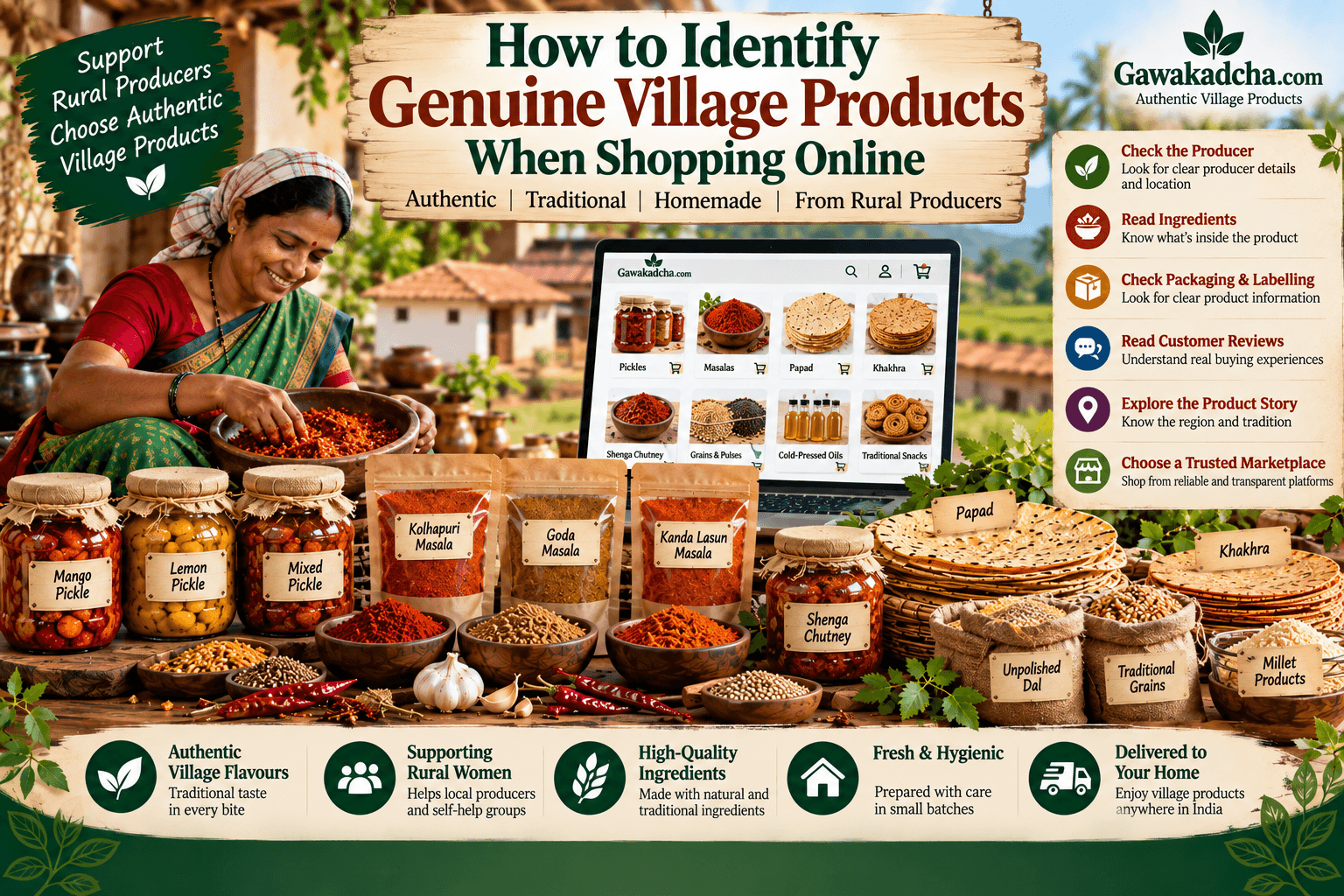
How to Identify Genuine Village Products When Shopping Online
Authentic • Traditional • Homemade • Rural Producers • Trusted Online Shopping
The internet has made it easier than ever to discover traditional Indian foods and products from different villages and regions. From homemade pickles and Maharashtrian masalas to Shenga Chutney, papad, millet products, cold-pressed oils and traditional snacks, customers can now explore products that were once available mainly in local markets.
But online shopping also creates an important question:
How can you identify genuine village products when shopping online?
A product may use words such as traditional, homemade, authentic, village-made or rural product in its description. However, these words alone do not prove where or how a product was actually made.
A smarter approach is to look at the producer information, ingredients, product story, packaging, labelling, reviews, transparency and marketplace credibility.
This guide explains how to identify genuine village products online and make more informed purchasing decisions while supporting rural producers and traditional food businesses.
What Are Village Products?
Village products are goods associated with rural producers, traditional artisans, farmers, home-based businesses, Self-Help Groups or small-scale enterprises operating in rural communities.
In the food category, they may include:
Homemade pickles
Maharashtrian masalas
Shenga Chutney
Papad
Khakhra
Traditional snacks
Millet products
Traditional flour mixes
Pulses and grains
Cold-pressed oils
Regional food products
The important point is that "village product" is not simply a marketing label.
A genuinely rural-origin product should have a traceable producer, clear product information and a believable connection to the community or region it represents.
Why Are Village Products Becoming Popular Online?
Modern consumers are increasingly interested in products that offer something different from mass-market alternatives.
They may be looking for:
Authentic Taste + Regional Identity + Traditional Recipes + Small Producers
For people who have moved from villages to cities, these products can also recreate familiar flavours from home.
A traditional pickle, masala or snack can remind customers of:
Family recipes
Festivals
Village kitchens
Regional food traditions
Childhood memories
At the same time, online marketplaces have made these products accessible to customers who may live hundreds of kilometres away from the producer.
1. Check Who Actually Makes the Product
One of the first things to check when buying a genuine village product online is the producer.
A trustworthy product listing should ideally provide information such as:
Producer or manufacturer name
Business name where applicable
Location
Product details
Contact or customer-support information
Relevant registration or food-related information where applicable
If a website claims that a product is made by a rural woman entrepreneur or village-based producer but provides absolutely no information about the producer, be cautious.
Ask:
Who made this product?
Where is it made?
Is the producer identified?
Transparency is one of the strongest indicators of a credible product listing.
2. Don't Judge Authenticity Only by the Product Photograph
A rustic background, traditional utensils, village scenery or a photograph of a woman preparing food can create a strong impression.
But photographs alone cannot prove authenticity.
A genuine product should have more than attractive visuals.
Look for:
Product Information + Producer Details + Ingredients + Packaging + Reviews
A beautiful photograph can support a product story, but it shouldn't be the only evidence behind that story.
3. Look for a Clear Product Story
A genuine regional product often has a story behind it.
For example:
Which region is it associated with?
What traditional recipe is used?
Who prepares it?
What ingredients are commonly used?
What makes the product different?
Is it made by an individual producer, family business or Self-Help Group?
A good product description should explain these details naturally without making exaggerated claims.
For example, instead of simply saying:
"100% authentic village pickle"
a stronger product description might explain the type of pickle, key ingredients, regional connection, producer and preparation style.
Specific information is more useful than generic marketing words.
4. Read the Ingredient List Carefully
For food products, ingredients are extremely important.
Suppose you are buying homemade Maharashtrian pickle.
You may want to know:
Main ingredient
Oil used
Spices
Salt
Other ingredients
Similarly, for masalas, check the listed spice ingredients.
For millet products, check which grains are actually used.
For snacks, check the flour, spices and other ingredients.
Remember:
The product name tells you what it is called.
The ingredient list tells you what is actually inside it.
This is one of the simplest ways to make a better online food-buying decision.
5. Check the Product's Location
If a product is promoted as a village product, the location can provide useful context.
Look for information about:
Village
Taluka
District
State
Producer location
Regional identity is particularly important for traditional food products.
For example, a Maharashtrian masala may have a specific regional food tradition behind it, while a village-made pickle may reflect local ingredients and preparation styles.
However, remember that a rural location alone does not automatically guarantee product quality.
It is one piece of the overall picture.
6. Check Packaging and Labelling
Authentic village products can have simple packaging, but simple does not have to mean unclear.
A commercially sold packaged food should provide appropriate product information according to applicable requirements.
When shopping online, look for information such as:
Product name
Net quantity
Ingredient information
Date information
Storage instructions
Producer/manufacturer details
Relevant food-related information where applicable
Good labelling helps customers understand what they are purchasing.
Important:
Don't assume that professionally designed packaging means a product is mass-produced.
Likewise, simple packaging doesn't automatically mean the product is homemade.
Look at the information, not just the appearance.
7. Look for Real Customer Reviews
Customer reviews can help you understand the actual buying experience.
Look for comments about:
Taste
Freshness
Packaging
Quantity
Product quality
Delivery
Overall experience
Reviews become even more useful when customers mention specific details.
For example:
"The pickle was tangy and moderately spicy, and the jar arrived securely packed."
This tells you much more than:
"Very good product."
However, reviews should be considered along with other information rather than treated as absolute proof of authenticity.
8. Check Whether the Marketplace Is Transparent
Where you buy the product matters.
A reliable online marketplace should make it reasonably easy for customers to understand:
What they are buying
Who supplies it
How much it costs
What quantity they receive
How it is packaged
How to contact customer support
What happens if there is an issue with the order
This transparency creates confidence for both customers and producers.
For rural products especially, the marketplace can play an important role in connecting small producers with urban customers.
9. Be Careful With "Homemade" Claims
The word homemade has strong emotional appeal.
Customers often associate it with:
Traditional recipes
Small batches
Familiar ingredients
Family kitchens
Authentic flavours
But the word alone should not determine your purchase.
Ask:
Who makes it?
Where is it made?
What are the ingredients?
How is it packaged?
Is the product information transparent?
A genuine homemade-style product should have a story and information that support the claim.
10. Compare the Product Description With the Label
This is a very useful online-shopping habit.
Suppose the website says:
"Traditional Millet Snack"
Check the actual ingredients.
If it says:
"Homemade Mango Pickle"
Check the ingredient list and producer details.
If it says:
"Cold-Pressed Oil"
Look for product-specific information about the oil and producer.
The description and label should be consistent.
If the marketing claims sound very different from the actual product information, consider choosing another product.
11. Check the Price—But Don't Use Price Alone to Judge Authenticity
A common assumption is:
Cheap = Not Authentic
or
Expensive = Premium and Genuine
Neither is necessarily true.
The price of a rural food product can depend on:
Ingredients
Labour
Packaging
Quantity
Logistics
Marketplace costs
Production scale
Product type
A small producer may have higher per-unit production costs than a large manufacturer.
At the same time, a high price alone does not prove authenticity.
Compare:
Quantity + Ingredients + Quality + Packaging + Producer + Reviews
rather than comparing only the selling price.
12. Look for the Human Story Behind the Product
One of the most valuable aspects of genuine village products is the person behind them.
A rural food business may be operated by:
A woman entrepreneur
A family
A Self-Help Group
A farmer
A small food-processing unit
A village-based enterprise
When the marketplace shares the producer's story responsibly, customers can better understand where their purchase comes from.
This creates something more meaningful than a simple transaction.
Customer → Product → Producer → Community
13. Traditional Does Not Mean Automatically Better
This is an important distinction.
A traditional product can be culturally valuable and delicious, but customers should still evaluate it based on their own requirements.
For food products, consider:
Ingredients
Salt
Sugar
Oil
Portion size
Nutrition information
Storage requirements
Don't assume that a food is automatically healthier simply because it is described as traditional or homemade.
Authenticity and nutritional value are different questions.
14. Look for Regional Specialities
One way to discover genuine village products is to explore products strongly connected with a particular region.
For example, Maharashtra has a rich food culture featuring:
Maharashtrian masalas
Shenga Chutney
Pickles
Bhakri-related foods
Papad
Traditional snacks
Millet foods
Regional flour mixes
Regional specialities often provide more context about the origin and cultural identity of a product.
But again, always verify the product-specific information.
15. Check Whether the Product Is Suitable for Online Delivery
A genuine village product still needs to reach you in good condition.
Before ordering, check:
Packaging
Is it suitable for transportation?
Shelf Life
Will it remain suitable during the expected delivery period?
Storage
Does it require any specific storage?
Delivery Information
Does the seller clearly explain delivery coverage and timelines?
This is particularly important for products such as pickles, papad, snacks, flour products and oils.
Genuine Village Product Checklist
Before purchasing, ask these 10 questions:
1. Who makes it?
Is the producer clearly identified?
2. Where is it made?
Is the location mentioned?
3. What is inside it?
Are ingredients clearly listed?
4. Is the product description detailed?
Does it explain the product rather than simply using marketing words?
5. Is the packaging appropriate?
Can it protect the product during delivery?
6. Is the label clear?
Are relevant product details available?
7. Are there genuine customer reviews?
Do customers describe their actual experience?
8. Is the seller transparent?
Can you contact them if there is a problem?
9. Is the price reasonable for the quantity?
Compare the complete product, not just the headline price.
10. Does the story make sense?
Do the producer, location, product and description tell a consistent story?
If most of these questions have clear answers, you are in a much better position to make an informed purchase.
Red Flags to Watch for When Shopping Online
Not every product labelled "village," "organic," "homemade" or "traditional" is necessarily genuine.
Be cautious when you see:
Vague Product Information
No clear ingredients, producer or quantity.
Unrealistic Claims
Statements that sound too good to be true.
No Producer Information
The product is promoted as rural-made but the producer is completely unidentified.
Poor Labelling
Important product information is missing or difficult to understand.
No Customer Support
There is no clear way to contact the seller.
Only Stock Images
The product page provides generic photographs without useful product details.
These signs don't automatically prove that a product is fake, but they should encourage you to investigate further.
How Gawakadcha.com Helps Customers Discover Village Products
Gawakadcha.com is built around the idea of bringing traditional and rural food products closer to modern customers.
The platform enables customers to explore categories such as:
Homemade Pickles
Maharashtrian Masalas
Shenga Chutney
Khakhra
Papad and Fryums
Traditional Grains
Unpolished Pulses
Cold-Pressed Oils
Millet Products
Traditional Snacks
Ready-to-Make Traditional Foods
The objective is not simply to sell products online.
It is to create a connection between rural producers and customers across India.
For customers, this means easier access to regional flavours.
For producers, digital commerce can create access to markets beyond their immediate village or town.
Why Supporting Genuine Village Products Matters
When customers intentionally purchase from genuine rural producers, they can contribute to a broader ecosystem.
A successful order can mean:
Customer Purchase → Producer Revenue → Continued Production → Rural Business Opportunity
For women entrepreneurs and small food businesses, repeat customers can be particularly valuable.
A customer's review, recommendation or second order can help a small producer build confidence and gradually expand.
This is one reason conscious purchasing can have an impact beyond the product itself.
How to Shop Smart for Village Products Online
Here is a simple process you can follow every time.
Step 1: Discover
Search for the traditional product you want.
Step 2: Compare
Look at multiple products rather than choosing the first result.
Step 3: Verify
Check producer, ingredients, location and product details.
Step 4: Read Reviews
Look for specific customer experiences.
Step 5: Check Packaging
Make sure the product is suitable for online delivery.
Step 6: Check Quantity and Price
Compare value rather than just price.
Step 7: Order a Small Quantity First
If you are trying a new producer, starting with a smaller quantity can help you evaluate the product.
Step 8: Review and Reorder
If you genuinely like the product, leave a useful review and consider becoming a repeat customer.
Frequently Asked Questions
How can I identify genuine village products online?
Check the producer details, location, ingredients, product description, packaging, labelling, reviews and marketplace transparency. Don't rely only on words such as "homemade" or "traditional."
What makes a village product authentic?
Authenticity comes from a genuine connection between the product, producer, preparation tradition and region. Clear and consistent product information helps customers evaluate this connection.
Are homemade products always better?
Not automatically. Homemade-style products can offer traditional flavours, but customers should still check ingredients, hygiene-related information, packaging, shelf life and other product details.
How do I know if a homemade pickle is genuine?
Check who produces it, where it is made, the ingredients, packaging, date information, storage instructions and customer reviews.
Should I trust a product just because it says "traditional"?
No. "Traditional" is a description, not proof by itself. Look for specific information about the product and producer.
How can I support rural women entrepreneurs?
Purchase genuine products from rural producers, leave honest reviews, recommend products you genuinely like and help spread awareness about small businesses.
Are village products available online?
Yes. Many rural and regional food products are now available through online marketplaces, making them accessible to customers outside their local areas.
Where can I buy traditional village food products online?
You can explore traditional and regional food products on Gawakadcha.com, subject to product availability and delivery coverage.
Conclusion
Shopping for genuine village products online should be about more than attractive photographs and words such as "homemade" or "traditional."
A smarter customer looks deeper:
Who made it?
Where is it made?
What's inside it?
How is it packaged?
What do other customers say?
When these questions have clear answers, you can make a much more informed purchasing decision.
From Maharashtrian masalas and homemade pickles to Shenga Chutney, khakhra, papad, traditional grains and cold-pressed oils, India's rural food producers have an enormous variety of products to offer.
Online commerce gives these products an opportunity to travel from village kitchens to customers across India.
And when customers choose genuine products, they aren't just discovering new flavours. They are also helping traditional recipes, small businesses and rural entrepreneurship find a place in the modern marketplace.
Authentic Products • Traditional Recipes • Rural Entrepreneurs • From Village to Your Doorstep