
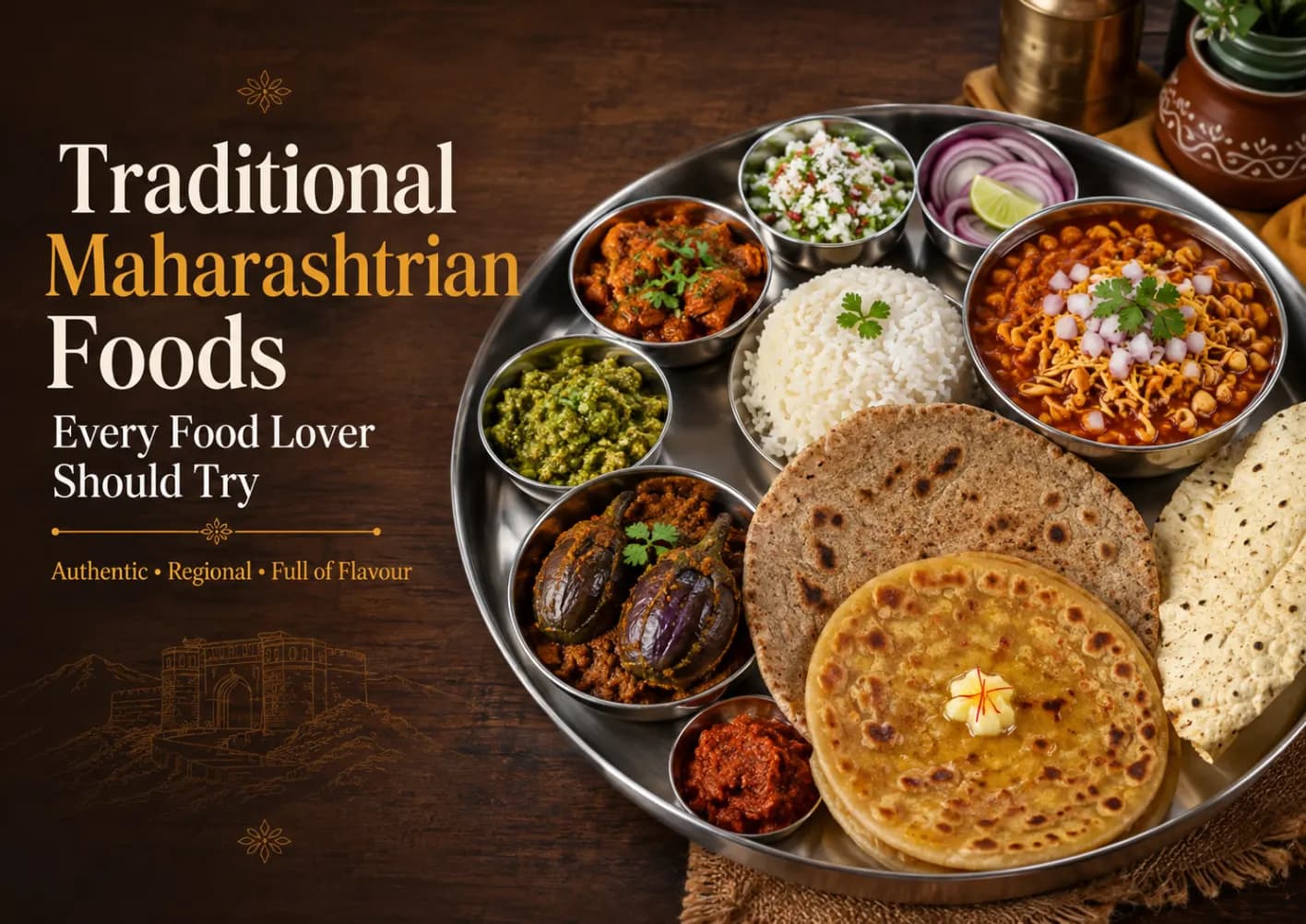
Maharashtra is home to one of India’s most diverse and flavourful food cultures. From the coconut-rich curries of the Konkan coast to the spicy gravies of Kolhapur, the millet-based village meals of Marathwada and the bold Saoji cuisine of Vidarbha, every region contributes something unique to the Maharashtrian plate.
Traditional Maharashtrian food is known for its balanced use of grains, pulses, vegetables, peanuts, sesame seeds, coconut, jaggery, kokum and aromatic spice blends. Some dishes are fiery and intense, while others are mildly sweet, comforting or naturally tangy.
Although Vada Pav and Misal Pav are among the most famous Maharashtrian dishes, the state’s cuisine extends far beyond street food. It includes nourishing everyday meals, festive sweets, regional curries, homemade chutneys, traditional snacks and recipes passed down through generations.
Whether you are exploring authentic Indian cuisine, searching for famous Maharashtra foods or planning a traditional Maharashtrian thali, these 21 dishes deserve a place on your food list.
What Makes Maharashtrian Cuisine Unique?
The food of Maharashtra changes significantly as you travel from one region to another.
Coastal areas frequently use coconut, rice, kokum and seafood. Inland regions rely more heavily on jowar, bajra, wheat, pulses, groundnuts and seasonal vegetables. Kolhapuri food is recognised for its bold masalas and rich gravies, while Vidarbha is known for intensely spiced Saoji preparations.
Several elements give authentic Maharashtrian cuisine its distinctive character:
-
Jowar and bajra bhakri
-
Fresh and dried coconut
-
Peanuts and sesame seeds
-
Kokum and tamarind
-
Goda Masala and Kala Masala
-
Garlic and chilli chutneys
-
Seasonal vegetables
-
Pulses and sprouted legumes
-
Jaggery-based festive sweets
-
Traditional homemade pickles and papad
This combination of local ingredients and regional cooking methods creates meals that feel rustic, satisfying and deeply connected to Maharashtra’s agricultural traditions.
21 Traditional Maharashtrian Foods You Must Try
1. Misal Pav
Misal Pav is one of the most popular Maharashtrian foods and a favourite among people who enjoy spicy and flavourful meals.
The main component is usually a curry made from sprouted matki or moth beans. It is topped with farsan, chopped onion, coriander and lemon, then served with soft pav. The spicy liquid gravy served with misal is commonly called tarri or kat.
Different cities have developed their own versions. Kolhapuri Misal is generally known for its intense heat, while Puneri and Nashik styles offer their own balance of spices, texture and toppings.
Misal Pav works as breakfast, brunch or a complete meal.
Popular search terms: Misal Pav, Maharashtrian Misal, authentic Misal Pav, Kolhapuri Misal, famous Maharashtrian street food
2. Vada Pav
Often associated with Mumbai’s fast-moving food culture, Vada Pav is one of Maharashtra’s most recognisable street foods.
It consists of a spiced potato filling coated in gram-flour batter and deep-fried. The vada is placed inside a pav and served with green chutney, tamarind chutney, dry garlic chutney or fried green chilli.
Its simple ingredients, bold taste and convenient format have made Vada Pav popular across India.
For many food lovers, no exploration of Mumbai street food is complete without trying an authentic Vada Pav.
3. Pithla Bhakri
Pithla Bhakri represents the simplicity and warmth of traditional village food in Maharashtra.
Pithla is a smooth or slightly thick preparation made primarily with gram flour, water, turmeric, mustard seeds, garlic, chilli and coriander. It is usually served with jowar or bajra bhakri.
A complete plate may also include raw onion, green chilli, homemade pickle and thecha.
Pithla Bhakri is especially associated with rural households because it uses familiar pantry ingredients and can be prepared without an elaborate cooking process.
4. Zunka Bhakri
Zunka is a drier version of a gram-flour-based preparation. It is cooked with onion, mustard seeds, turmeric, garlic, chilli and coriander until it develops a crumbly texture.
It is commonly paired with jowar or bajra bhakri, raw onion and spicy thecha.
Zunka Bhakri is a classic example of how Maharashtrian cuisine transforms simple ingredients into a satisfying traditional meal.
Although Pithla and Zunka use similar ingredients, their consistency and cooking method create noticeably different eating experiences.
5. Thalipeeth
Thalipeeth is a traditional multigrain flatbread prepared using bhajani flour.
Bhajani may contain roasted jowar, bajra, rice, wheat, chana dal, urad dal, coriander seeds or other locally preferred ingredients. Onion, coriander, cumin, chilli and spices are mixed into the flour before the dough is shaped by hand and cooked on a tawa.
Thalipeeth is generally served with curd, butter, ghee, pickle or homemade chutney.
Its rustic texture and roasted flavour make it one of the most distinctive traditional Maharashtrian breakfast foods.
6. Hurda Dhapate
Dhapate is a traditional Maharashtrian flatbread commonly prepared with a mixture of grains, pulses, spices, herbs and curd.
Hurda Dhapate uses ingredients inspired by Maharashtra’s winter hurda season, when tender green jowar is enjoyed in farming regions. Recipes can vary between households, but Dhapate usually has a savoury, rustic and mildly spicy character.
It may be served with:
-
Plain curd
-
Groundnut chutney
-
Homemade pickle
-
White butter
-
Thecha
-
Seasonal vegetable curry
Ready-to-make Dhapate flour mixes can make it easier for modern families to prepare this regional food at home while maintaining its traditional character.
7. Bharli Vangi
Bharli Vangi means stuffed brinjal and is one of the most loved vegetable dishes in Maharashtrian home cooking.
Small brinjals are filled with a spice mixture that may include roasted peanuts, sesame seeds, coconut, onion, garlic, jaggery and regional masala. They are then cooked slowly until soft and well coated with the rich gravy.
Depending on the household and region, the dish may taste spicy, nutty, slightly sweet or tangy.
Bharli Vangi is commonly served with bhakri, chapati or rice and is often included in a traditional Maharashtrian thali.
8. Varan Bhaat
Varan Bhaat is among the simplest and most comforting Maharashtrian meals.
Varan is generally prepared with cooked toor dal, turmeric and a light tempering. It is served over steamed rice, often with ghee and lemon.
Unlike heavily spiced dal preparations, Varan allows the natural flavour of the lentils to remain prominent.
Varan Bhaat frequently forms part of festive meals and traditional family lunches. It can be accompanied by vegetable dishes, papad, pickle, chutney and koshimbir.
9. Amti
Amti is a traditional Maharashtrian dal preparation known for combining spicy, sweet and tangy flavours.
It is commonly prepared using toor dal along with Goda Masala, jaggery, tamarind or kokum and a seasoned tempering. The precise flavour varies according to region and family tradition.
Amti is usually served with steamed rice, bhakri or chapati.
Its distinctive combination of lentils and aromatic masala separates it from many other Indian dal recipes.
10. Kanda Poha
Kanda Poha is one of the most popular breakfast dishes in Maharashtra.
Flattened rice is cooked with onion, mustard seeds, turmeric, curry leaves, green chilli and peanuts. It is generally finished with coriander, grated coconut and lemon.
Poha is light, quick to prepare and easy to customise. Some people add peas, potato, pomegranate or sev, while others prefer the traditional onion-and-peanut version.
Kanda Poha is served in homes, restaurants, roadside stalls and social gatherings throughout the state.
11. Sabudana Khichdi
Sabudana Khichdi is commonly prepared during fasting occasions, but it is enjoyed throughout the year as a breakfast or snack.
Soaked sabudana is cooked with roasted peanut powder, cumin, green chilli, potato and ghee or oil. Lemon and coriander are often added before serving.
The ideal Sabudana Khichdi has separate, soft pearls rather than a sticky texture. Correct soaking and careful cooking are essential for achieving the desired result.
It is usually served with curd, cucumber raita or lemon.
12. Kothimbir Vadi
Kothimbir Vadi is a savoury Maharashtrian snack made primarily with fresh coriander and gram flour.
The mixture is flavoured with sesame seeds, chilli, ginger, garlic and spices. It is then steamed, cut into pieces and eaten as it is or lightly fried for a crisp exterior.
This traditional snack offers a combination of fresh coriander aroma, mild bitterness, spice and a soft interior.
Kothimbir Vadi is generally served with green chutney or tea.
13. Alu Vadi
Alu Vadi, also known as Patra in some regions, is prepared using colocasia leaves coated with a seasoned gram-flour mixture.
The leaves are layered, tightly rolled, steamed and sliced. The pieces may then be tempered or shallow-fried.
The filling often balances spicy, sweet and tangy flavours using chilli, jaggery and tamarind.
Preparing Alu Vadi requires proper handling and cooking of colocasia leaves, making it a dish closely associated with traditional household knowledge.
14. Thecha
Thecha is a powerful Maharashtrian condiment made using green or red chillies, garlic, peanuts and salt.
The ingredients are traditionally roasted or crushed together to create a coarse chutney. Some versions use sesame seeds, coriander or a touch of oil.
Thecha is generally served in small quantities with:
-
Bhakri
-
Pithla
-
Zunka
-
Dal-rice
-
Khichdi
-
Simple vegetable meals
Its bold taste can transform an ordinary plate into a distinctly Maharashtrian dining experience.
15. Solapuri Shenga Chutney
Shenga Chutney is a dry groundnut chutney with a roasted, savoury and spicy taste. It is especially popular in Solapur and other parts of Maharashtra.
The chutney is commonly made with roasted peanuts, garlic, red chilli, cumin and salt. Recipes vary depending on the household and regional preference.
It can be eaten with:
-
Jowar bhakri
-
Chapati
-
Dal-rice
-
Idli
-
Dosa
-
Dhapate
-
Simple vegetable dishes
Because it is dry and flavourful, Shenga Chutney is also convenient for travel and packed meals.
16. Ukadiche Modak
Ukadiche Modak is one of Maharashtra’s most treasured festive sweets.
The outer covering is made from steamed rice flour dough, while the filling generally contains freshly grated coconut, jaggery and cardamom. The shaped modaks are steamed until soft.
Ukadiche Modak is strongly associated with Ganesh Chaturthi and is traditionally offered to Lord Ganesha.
The delicate rice covering and aromatic coconut-jaggery filling make it very different from fried modak varieties.
17. Puran Poli
Puran Poli is a festive sweet flatbread prepared with a filling of cooked chana dal, jaggery and aromatic spices.
The filling, called puran, is enclosed in a soft wheat-based dough and carefully rolled before being cooked on a tawa.
It is often served with:
-
Ghee
-
Milk
-
Katachi Amti
-
Plain dal
-
Seasonal festive dishes
Puran Poli is commonly prepared during Holi, Gudi Padwa, Dussehra and family celebrations.
Its preparation requires patience and practice, making it a dish that reflects both culinary skill and family tradition.
18. Kolhapuri Tambda Rassa and Pandhra Rassa
Kolhapuri cuisine is known for strong spice blends and deeply flavoured gravies.
Tambda Rassa is a red, spicy gravy prepared using roasted spices and chilli. Pandhra Rassa is a lighter-coloured gravy traditionally made with coconut, spices and stock.
These gravies are commonly served as part of a non-vegetarian meal with mutton, bhakri or rice.
Together, they demonstrate how Kolhapuri cooking creates contrasting flavours within the same meal—one fiery and robust, the other comparatively mild and aromatic.
19. Malvani Fish Curry
Malvani Fish Curry represents the coastal food traditions of Maharashtra’s Konkan region.
The curry generally uses fresh fish, coconut, chilli, coriander, kokum or tamarind and Malvani Masala. The result is spicy, tangy and aromatic.
It is usually served with steamed rice, rice bhakri or chapati.
Malvani cooking reflects the geography of the Konkan coast through its frequent use of coconut, rice, seafood and souring ingredients.
Vegetarian Malvani gravies may also be prepared using legumes, vegetables or cashews.
20. Solkadhi
Solkadhi is a refreshing coastal beverage made with kokum and coconut milk.
It has a naturally tangy taste, a pale pink colour and a subtle flavour from garlic, cumin, chilli or coriander, depending on the recipe.
Solkadhi is commonly served with rice, fish curry or Malvani meals. Some households serve it after the main meal.
Its combination of coconut and kokum makes it one of the most recognisable beverages of Konkan cuisine.
21. Saoji Mutton or Saoji Curry
Saoji cuisine is associated with Nagpur and parts of Vidarbha. It is known for dark, intensely spiced gravies made with a complex mixture of roasted spices.
Saoji Mutton is one of the cuisine’s most famous preparations, although chicken and vegetarian Saoji dishes are also available.
The gravy may include black pepper, dry coconut, poppy seeds, chilli and several whole spices. Exact spice combinations are often closely guarded family or restaurant recipes.
Saoji food is best suited to people who enjoy bold, hot and deeply aromatic curries.
Traditional Maharashtrian Sweets Worth Trying
Maharashtrian cuisine includes several festive and regional sweets in addition to Puran Poli and Ukadiche Modak.
Popular options include:
-
Shrikhand
-
Basundi
-
Tilgul Ladoo
-
Gul Poli
-
Narali Bhaat
-
Anarsa
-
Karanji
-
Shankarpali
-
Rava Ladoo
-
Besan Ladoo
-
Coconut Ladoo
-
Amrakhand
Many of these sweets are linked to specific festivals, seasons or religious traditions.
For example, Tilgul is strongly associated with Makar Sankranti, Modak with Ganesh Chaturthi and Puran Poli with festivals such as Gudi Padwa and Holi.
Popular Maharashtrian Street Foods
Food lovers exploring Mumbai, Pune, Nashik, Kolhapur or other cities should also try Maharashtra’s street-food culture.
Some of the most popular Maharashtrian street foods include:
-
Vada Pav
-
Misal Pav
-
Pav Bhaji
-
Kanda Bhaji
-
Sabudana Vada
-
Bhel Puri
-
Ragda Pattice
-
Batata Vada
-
Kanda Poha
-
Thalipeeth
-
Dabeli
-
Bombay-style sandwiches
Street-food preparations can vary considerably between locations. Choose vendors that maintain proper hygiene, use fresh ingredients and serve food at safe temperatures.
What Is Included in a Traditional Maharashtrian Thali?
A traditional Maharashtrian thali varies by region, season and occasion. A typical homemade vegetarian thali may include:
-
Chapati or puri
-
Jowar or bajra bhakri
-
Steamed rice
-
Varan or Amti
-
Seasonal vegetable
-
Usal or sprouted pulse preparation
-
Bharli Vangi
-
Koshimbir
-
Pickle
-
Papad
-
Thecha or Shenga Chutney
-
Buttermilk
-
Puran Poli or another sweet
A coastal thali may include rice, fish curry, fried fish, vegetable dishes and Solkadhi.
A Kolhapuri non-vegetarian thali may include mutton, Tambda Rassa, Pandhra Rassa, bhakri and rice.
The diversity of the Maharashtrian thali makes it one of the best ways to experience several regional flavours in one meal.
Essential Maharashtrian Masalas and Ingredients
Authentic taste often depends on the spice mixture and cooking technique rather than simply increasing the quantity of chilli.
Important Maharashtrian ingredients and masalas include:
Goda Masala
Goda Masala is an aromatic spice blend commonly used in Amti, Bharli Vangi, Usal and vegetable preparations. Its ingredients may include coriander seeds, sesame, coconut, cumin, cinnamon, cloves and other spices.
Kala Masala
Kala Masala is a deeply roasted spice blend that gives curries and gravies a bold colour and flavour. Recipes differ across regions and households.
Malvani Masala
Malvani Masala is associated with coastal cuisine and is used in seafood, chicken, legumes and vegetable gravies.
Kolhapuri Masala
This masala is used in robust Kolhapuri gravies and can contain roasted chilli, coconut, coriander and whole spices.
Yesur Banga Masala
Yesur Banga Masala is a traditional regional spice blend used to add strong colour, aroma and depth to curries and gravies.
Groundnut and Sesame
Peanuts and sesame seeds are used in chutneys, stuffed vegetables, curries and dry spice mixtures.
Kokum
Kokum adds tanginess to coastal curries, beverages and Solkadhi.
Jowar and Bajra
These millets are widely used to make bhakri and other traditional rural foods.
Vegetarian Maharashtrian Foods for First-Time Visitors
For someone trying Maharashtrian cuisine for the first time, the following combination offers a broad introduction:
-
Kanda Poha for breakfast
-
Kothimbir Vadi as a snack
-
Misal Pav for brunch
-
Pithla Bhakri with Thecha for lunch
-
Bharli Vangi and Amti for dinner
-
Solkadhi as a refreshing accompaniment
-
Puran Poli or Ukadiche Modak for dessert
This selection includes street food, village food, festive food and home-style Maharashtrian dishes.
How to Enjoy Authentic Maharashtrian Food at Home
Preparing every regional recipe from scratch can require time, experience and access to the correct ingredients. However, families can make the process easier with a few practical steps.
Use Traditional Flour Mixes
Ready-to-make flour mixes for Dhapate, Thalipeeth and other regional flatbreads can reduce preparation time.
Choose Authentic Masalas
Using a traditional Kala Masala, Malvani Masala, Kanda-Lasun Masala or regional spice blend can bring greater depth to homemade curries.
Serve Regional Accompaniments
A small serving of Thecha, Shenga Chutney, pickle or papad can make a simple meal feel more authentically Maharashtrian.
Include Local Grains
Use jowar, bajra, ragi and other grains alongside wheat and rice.
Cook According to the Season
Traditional food culture frequently uses ingredients according to seasonal availability. Summer may bring papad, pickles and dried foods, while winter is associated with hurda, millet-based meals and warming spice combinations.
How Gawakadcha.com Helps Preserve Traditional Flavours
Regional dishes survive when people continue preparing, sharing and purchasing them.
Gawakadcha.com connects customers with selected village-based products and regional makers offering items such as:
-
Traditional Maharashtrian masalas
-
Ready-to-make flour mixes
-
Homemade pickles
-
Dry chutneys
-
Papad
-
Dried foods
-
Grains and pulses
-
Cold-pressed oils
-
Regional snacks
By making these products available online, the platform helps customers discover authentic rural flavours while supporting small producers, women-led groups and traditional food knowledge.
Customers should always review the ingredients, allergen information, producer details, shelf life and storage instructions before purchasing any food product.
Frequently Asked Questions
What is the most famous food of Maharashtra?
Vada Pav, Misal Pav, Puran Poli, Pithla Bhakri, Modak, Kanda Poha and Pav Bhaji are among the best-known Maharashtrian foods.
Which traditional Maharashtrian food should I try first?
Misal Pav is a good choice for people who enjoy spicy food. For a home-style meal, try Pithla Bhakri, Bharli Vangi or Varan Bhaat. Puran Poli and Ukadiche Modak are excellent choices for sweets.
What is an authentic Maharashtrian village meal?
A traditional village-style meal may include jowar or bajra bhakri, Pithla or Zunka, seasonal vegetables, raw onion, Thecha, Shenga Chutney, pickle and buttermilk.
Is all Maharashtrian food very spicy?
No. While Kolhapuri and Saoji cuisines can be intensely spicy, dishes such as Varan Bhaat, Kanda Poha, Thalipeeth, Solkadhi and Ukadiche Modak are comparatively mild.
What is the difference between Pithla and Zunka?
Both are prepared mainly with gram flour. Pithla usually has a smooth, semi-liquid consistency, whereas Zunka is cooked until it becomes drier and crumbly.
What are the best vegetarian Maharashtrian dishes?
Popular vegetarian options include Misal Pav, Pithla Bhakri, Zunka Bhakri, Thalipeeth, Bharli Vangi, Varan Bhaat, Amti, Kothimbir Vadi, Alu Vadi, Sabudana Khichdi and Puran Poli.
What are the most popular Maharashtrian sweets?
Puran Poli, Ukadiche Modak, Shrikhand, Basundi, Tilgul Ladoo, Gul Poli, Anarsa, Karanji and Narali Bhaat are popular traditional sweets.
Which Maharashtrian dishes are made with millets?
Jowar Bhakri, Bajra Bhakri, Thalipeeth and some varieties of Dhapate use millets or multigrain flour.
Where can I buy traditional Maharashtrian food products online?
Customers can explore regional masalas, flour mixes, pickles, chutneys, papad, grains and other village products through trusted online platforms such as Gawakadcha.com.
Conclusion
Traditional Maharashtrian food is much more than Misal Pav and Vada Pav. It is a diverse cuisine shaped by Maharashtra’s coastlines, farmlands, festivals, communities and regional ingredients.
From the simplicity of Varan Bhaat and Pithla Bhakri to the richness of Bharli Vangi, the intensity of Saoji Curry and the festive sweetness of Puran Poli, every dish tells a different story.
Exploring these foods also means discovering traditional grains, homemade spice blends, local cooking methods and recipes preserved by generations of families.
Whether you prefer spicy street food, comforting village meals, coastal curries or traditional sweets, Maharashtrian cuisine offers something memorable for every food lover.