
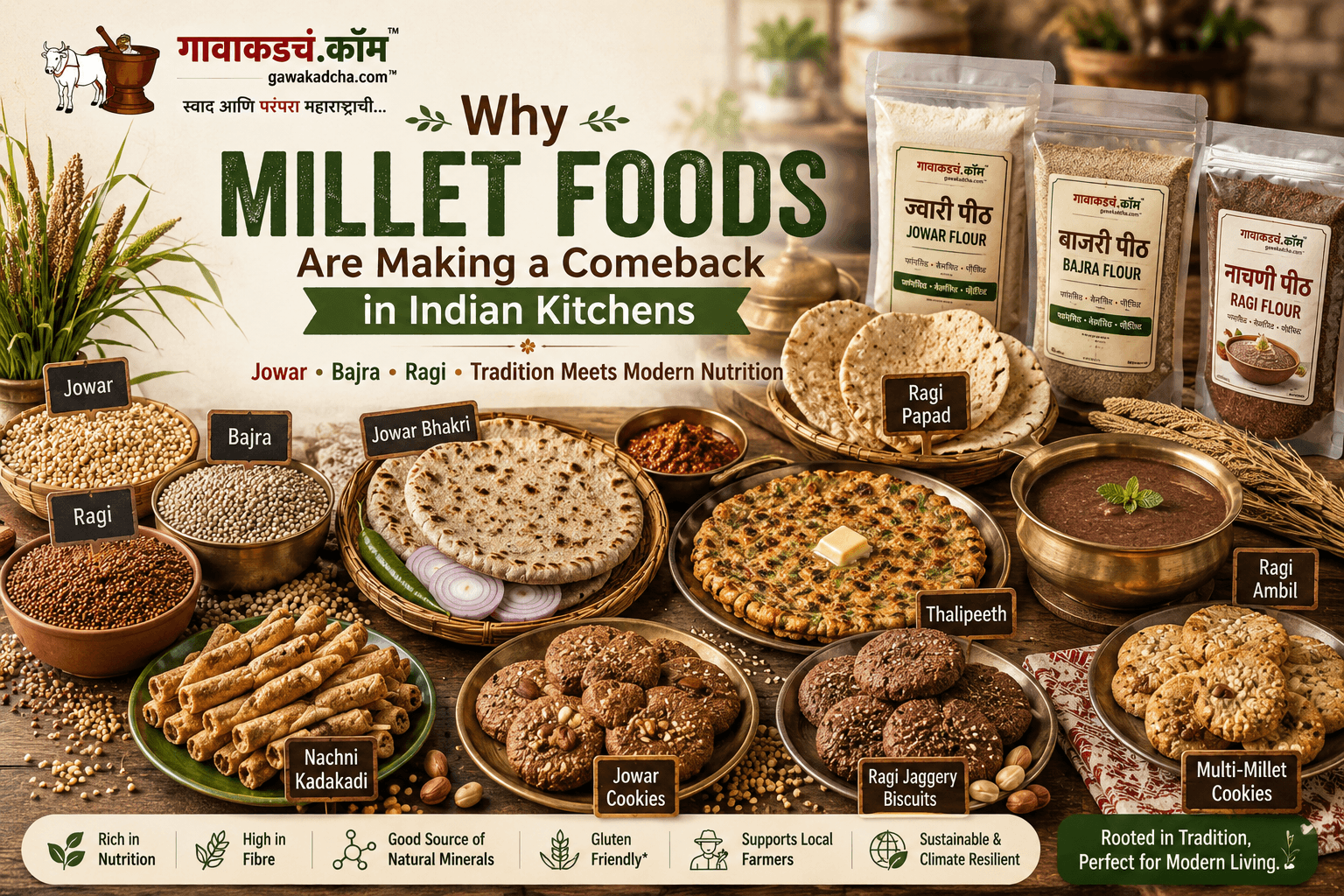
Why Millet Foods Are Making a Comeback in Indian Kitchens
For generations, grains such as Jowar, Bajra and Ragi were everyday foods in many Indian households. They appeared naturally in Bhakri, porridge, rotis, traditional snacks, fermented foods and seasonal village meals.
Then, over time, wheat and polished rice became more dominant in many urban diets.
Today, that trend is beginning to reverse.
Millets are once again appearing in supermarkets, restaurant menus, home kitchens and online marketplaces in forms ranging from Jowar Bhakri and Ragi Dosa to Bajra flour, millet cookies, papad, ready-to-cook mixes and traditional snacks.
Searches for terms such as millet foods, millet benefits, Jowar benefits, Bajra benefits, Ragi foods, healthy millet snacks and traditional Indian grains have also become increasingly common.
So why are millet foods making such a strong comeback in Indian kitchens?
The answer lies in a combination of nutrition awareness, traditional food revival, climate resilience, convenience, government support and changing consumer preferences.
Let us understand why these ancient grains are becoming relevant again.
What Are Millets?
Millets are a diverse group of small-grained cereals that have traditionally been grown in dry and semi-arid regions.
Common millet varieties consumed in India include:
Jowar or Sorghum
Bajra or Pearl Millet
Ragi or Finger Millet
Foxtail Millet
Little Millet
Kodo Millet
Barnyard Millet
Proso Millet
The Food and Agriculture Organization describes millets as ancient, climate-resilient grains that can provide fibre, minerals, vitamins and protein, with nutritional composition varying between varieties.
In Maharashtra, Jowar, Bajra and Ragi/Nachni are especially familiar.
They have traditionally been eaten as:
Bhakri
Dhapate
Thalipeeth
Porridge
Papad
Snacks
Flour preparations
In other words, millet foods are not a new invention.
They are old foods receiving new attention.
10 Reasons Millet Foods Are Making a Comeback
1. Consumers Are Rediscovering Whole and Traditional Grains
One of the biggest changes in Indian food behaviour is growing awareness around excessive dependence on refined foods.
Consumers increasingly want to know:
Which grain is being used?
Is the flour refined?
Is the product made from whole grains?
What does the ingredient list contain?
Can we include greater grain diversity in our diet?
Millets fit naturally into this conversation.
ICMR-NIN’s Dietary Guidelines include whole millets and fresh millet flours among minimally processed grain foods.
This makes traditional millet preparations relevant for households trying to build meals around more varied grains.
2. Millets Offer Nutritional Diversity
Jowar, Bajra and Ragi do not have exactly the same nutritional profile.
Depending on the variety, millets can contribute different amounts of:
Dietary fibre
Protein
Iron
Calcium
Phosphorus
B vitamins
Other minerals
For example, Ragi is particularly known for its calcium content, while different millets contribute their own combinations of fibre and micronutrients.
FAO highlights millets as sources of minerals, dietary fibre, vitamins and protein.
The main advantage is therefore dietary diversity.
Instead of depending on wheat or rice for almost every cereal-based meal, families can rotate:
Wheat → Rice → Jowar → Bajra → Ragi
This creates more variety in everyday food.
3. Millet Foods Fit the Whole-Grain Movement
Modern nutrition discussions increasingly encourage whole grains instead of heavily refined cereal products.
Millets can naturally fit this trend when consumed in whole-grain or appropriately milled forms.
Traditional dishes such as:
Jowar Bhakri
Bajra Bhakri
Ragi Dosa
Millet Khichdi
Thalipeeth
can provide an alternative to meals dominated by refined flour.
However, one important distinction should be remembered:
A food containing millet is not automatically healthy.
For example, a millet cookie may still contain:
Added sugar
Butter
Vegetable fat
Refined flour
High calories
Consumers should therefore evaluate the complete ingredient list, not just the word “millet.”
4. Traditional Maharashtrian Food Is Becoming Popular Again
Regional Indian cuisine is experiencing a strong revival.
People are rediscovering:
Bhakri
Dhapate
Thalipeeth
Traditional chutneys
Regional masalas
Millet foods
Jowar Bhakri, for example, was never a “health trend” for rural Maharashtra.
It was simply food.
Today, the same dish is being rediscovered by younger urban consumers because it offers:
Regional identity
Traditional taste
Ingredient simplicity
Grain diversity
This demonstrates an important change.
Consumers are beginning to see traditional village foods not as outdated meals, but as foods that can fit into modern lifestyles.
5. International Year of Millets Increased Awareness
A major push came from the International Year of Millets 2023, declared by the United Nations after a proposal led by India.
The campaign highlighted the nutritional, cultural, agricultural and environmental importance of millets globally.
This helped move millet from a relatively overlooked grain category into mainstream conversations involving:
Nutrition
Farming
Food security
Restaurants
Food startups
Packaged foods
Government programmes
Although 2023 has passed, the awareness it created continues to influence product development and consumer demand.
6. Climate Resilience Makes Millets Important for Farmers
The millet comeback is not only about what happens in the kitchen.
It also matters in agriculture.
Many millet crops can tolerate:
Lower rainfall
Dry conditions
Poorer soils
Climate stress
better than some water-intensive crops.
FAO identifies drought resilience and relatively low input requirements as major advantages of several millet crops.
This becomes increasingly important as farmers deal with:
Changing rainfall patterns
Water scarcity
Temperature variability
Increasing climate uncertainty
Encouraging millet consumption can therefore help create market demand for crops that are already adapted to several dryland farming regions in India.
7. The Market Is Creating More Convenient Millet Products
One reason millet consumption declined in some households was convenience.
Preparing Jowar or Bajra Bhakri requires skill.
Many young city residents may not know how to handle millet dough.
Food businesses are now solving this problem by introducing millet in easier formats such as:
Ready flour
Cookies
Crackers
Papad
Breakfast mixes
Snacks
Pasta
Noodles
Ready-to-cook products
This allows people to experiment with millets without completely changing their daily cooking routine.
Gawakadcha currently carries products such as Ragi Jaggery Biscuits, Jowar Cookies, Multi-Millet Cookies, Homemade Ragi Papad, Nachni Kadakadi and Organic Bajra.
That variety shows how millet is moving from one traditional format into multiple modern food categories.
8. Millet Snacks Appeal to Younger Consumers
One of the strongest opportunities for millet foods is snacking.
Traditional millet meals may feel unfamiliar to some younger consumers.
But formats such as:
Millet cookies
Ragi rolls
Millet crackers
Papad
Baked snacks
are easier to introduce.
For example, Gawakadcha currently lists Multi-Millet Jaggery Butter Cookies made using Jowar, Ragi and Bajra alongside wheat and other ingredients.
It also lists Ragi-based biscuits and Jowar cookies.
This represents an important shift:
Traditional Grain → Familiar Modern Format
However, consumers should still compare sugar, fat and ingredient lists rather than assuming every millet snack is automatically nutritious.
9. Millet Foods Can Create Opportunities for Rural Producers
Millets have traditionally been grown in several rural and dryland regions of India.
When demand increases, opportunities can also grow for:
Farmers
Flour mills
Food processors
Rural women entrepreneurs
Self-help groups
Small snack producers
Regional brands
Instead of selling only raw millet grain, businesses can create value-added products.
For example:
Ragi → Ragi Papad
Jowar → Dhapate or Cookies
Bajra → Flour or Ready Mix
Mixed Millets → Snacks or Cookies
Value addition can help rural businesses earn through processing, packaging and branding—not only raw crop sales.
The Indian government has also expanded support for millet-processing businesses, with thousands of micro-enterprises receiving assistance through food-processing schemes.
10. Millets Match the Growing Interest in Local and Indian Foods
Another reason for the comeback is cultural.
Consumers increasingly want foods that feel:
Local
Regional
Traditional
Indian
Traceable
Millets fit perfectly.
They connect modern consumers with the crops and recipes their grandparents already knew.
A packet of Ragi Papad or a Jowar-based product is therefore not only another food item.
It represents:
Agriculture + Tradition + Regional Identity + Modern Convenience
That combination makes millets especially attractive to marketplaces focused on traditional Indian products.
Jowar vs Bajra vs Ragi: What’s the Difference?
Jowar
Jowar, or Sorghum, is especially popular in Maharashtra and Karnataka.
Common uses:
Bhakri
Dhapate
Flour
Cookies
Snacks
It has a mild, earthy taste and fits naturally into everyday Maharashtrian cooking.
Bajra
Bajra, or Pearl Millet, is widely consumed in Maharashtra, Rajasthan, Gujarat and other dryland regions.
It is commonly used for:
Bajra Bhakri
Khichdi
Flour
Winter meals
Bajra has a stronger, slightly nutty flavour.
Ragi
Ragi, or Finger Millet/Nachni, is commonly used in parts of South India and Maharashtra.
Popular preparations include:
Ragi Dosa
Porridge
Bhakri
Papad
Biscuits
Snacks
Ragi is especially well known for its naturally high calcium content compared with many cereal grains.
There is no need to identify one as the universal “best millet.”
Rotating different grains can provide greater dietary variety.
Are Millets Gluten-Free?
Millets themselves are naturally gluten-free.
However, that does not mean every millet food product is gluten-free.
For example, millet cookies may also contain:
Wheat flour
Semolina
Other gluten-containing ingredients
Gawakadcha’s Multi-Millet Jaggery Butter Cookies, for example, also contain whole wheat flour.
People with coeliac disease or medically diagnosed gluten intolerance should therefore check:
Ingredient lists
Allergen declarations
Cross-contamination statements
rather than relying only on the word “millet.”
Are Millet Foods Good for Weight Loss?
No millet directly causes weight loss.
Millets can fit into a balanced diet, particularly when used as whole or minimally processed grains.
But total calorie intake still matters.
For example:
Ragi Bhakri and Ragi Cookies are not nutritionally identical simply because both contain Ragi.
Cookies may contain added fat and sweeteners.
A better weight-management approach is to focus on:
Portion size
Vegetables
Pulses
Protein
Whole grains
Overall calorie intake
Physical activity
Millet can be part of that pattern—but it is not a shortcut.
Are Millets Good for Diabetes?
Whole millet foods may produce different blood-glucose responses compared with some refined cereals, and FAO notes that millets can have comparatively favourable glycaemic characteristics.
However, this should not be interpreted as saying that people with diabetes can eat unlimited millet foods.
Blood-glucose response depends on:
Millet variety
Flour particle size
Processing
Cooking method
Serving size
Other ingredients
A millet biscuit containing sweeteners is very different from whole-grain millet eaten with vegetables and pulses.
People managing diabetes should follow personalised dietary advice.
How to Add Millet Foods to Your Diet
You do not need to replace wheat and rice completely.
Start gradually.
Breakfast
Try:
Ragi Dosa
Millet Thalipeeth
Dhapate
Ragi-based breakfast foods
Lunch
Use:
Jowar Bhakri
Bajra Bhakri
Millet Khichdi
with Dal, vegetables and curd.
Snacks
Explore:
Ragi snacks
Millet papad
Millet cookies occasionally
while checking ingredients and portions.
Dinner
Pair millet Bhakri with:
Pithla
Dal
Vegetable curry
Shenga Chutney
This makes millets part of familiar meals rather than a separate “diet food.”
Millet Products on Gawakadcha.com
Gawakadcha currently offers several products that make millet foods easier to discover.
Examples include:
Organic Bajra / Pearl Millet
Homemade Ragi / Nachni Papad
Nachni Kadakadi / Ragi Crunchy Rolls
Ragi Jaggery Biscuits
Jowar Cookies
Multi-Millet Jaggery Butter Cookies
The current Multi-Millet Cookies combine Jowar, Ragi and Bajra, while Gawakadcha’s Ragi Jaggery Biscuits use Ragi together with wheat and oats.
This range demonstrates how traditional grains can appear in both traditional and contemporary formats.
Frequently Asked Questions
Why are millets becoming popular again?
Growing awareness of whole grains, regional foods, nutrition, climate-resilient agriculture and government promotion has renewed interest in millets.
Which are the most common millets in Maharashtra?
Jowar, Bajra and Ragi/Nachni are among the most familiar millet grains used in Maharashtrian food.
Are millet foods healthier than rice and wheat?
Not automatically. The answer depends on whether the food is whole or refined, how it is processed, portion size and the complete meal.
Is Jowar a millet?
Yes. Sorghum, commonly called Jowar in India, is grouped with millets in major food and agriculture initiatives.
Is Ragi good for children?
Ragi can be part of an age-appropriate balanced diet, but preparation, serving size and the child’s complete nutritional needs should be considered.
Are millet cookies healthy?
Some millet cookies provide millet ingredients, but they may also contain sugar, butter, wheat or other ingredients. Always read the complete label.
Where can I buy millet products online?
Customers can explore millet grains, Ragi Papad, millet snacks and cookies through regional marketplaces such as Gawakadcha.com.
Conclusion
Millet foods are not really “coming back” because they were never completely gone.
They remained part of rural kitchens, traditional Maharashtrian meals and dryland farming communities even when urban diets shifted heavily toward wheat and rice.
What has changed is consumer attention.
People are now rediscovering the value of:
Jowar • Bajra • Ragi • Traditional Grains • Regional Recipes
At the same time, food businesses are making these grains easier to consume through flour, papad, snacks and convenient products.
Millets also carry a larger story.
They connect nutrition with climate-resilient agriculture, farmers, traditional food culture and rural entrepreneurship.
That is why the millet comeback has the potential to last longer than an ordinary food trend.
The best approach is not to call every millet product a “superfood.”
It is to bring genuine millet grains and traditional recipes back into a diverse, balanced Indian diet.
Millets are not new foods for modern India—they are traditional foods finding a new generation.