
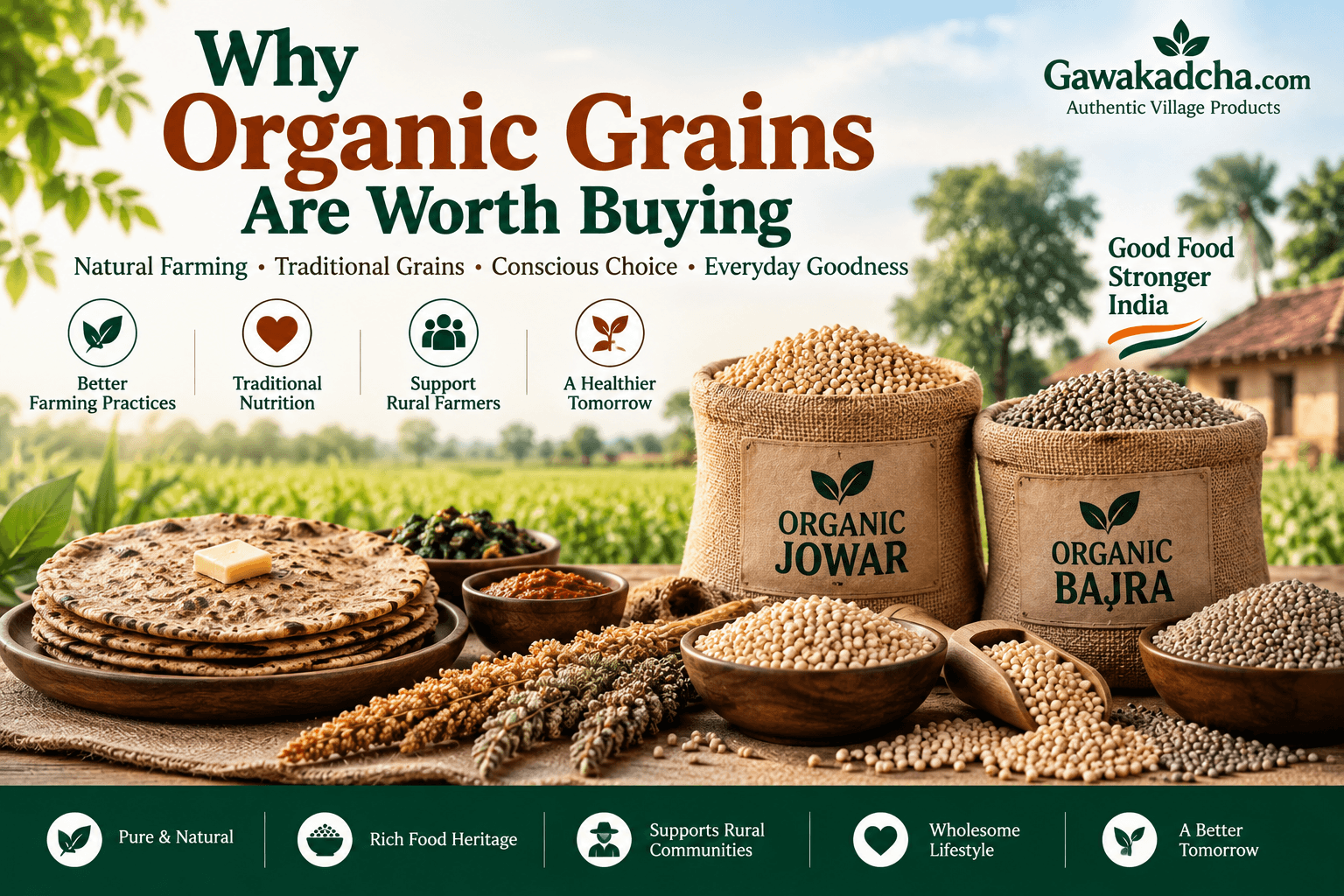
Why Organic Grains Are Worth Buying: Benefits, Quality and How to Choose the Right Ones
Natural • Wholesome • Traditional • Better Food Choices
In recent years, more Indian households have started paying closer attention to what goes into their everyday meals. From choosing traditional foods to reading product labels and exploring locally sourced ingredients, consumers are becoming more conscious about the quality and origin of their food.
One category receiving increasing attention is organic grains.
Grains such as Jowar, Bajra and other traditional cereals have been part of Indian diets for generations. Today, they are finding their way back into modern kitchens as people look for traditional ingredients, minimally processed foods and more conscious food choices.
But what exactly makes organic grains worth buying? Are they really different from conventional grains? How should you choose them?
This guide explains the key considerations and why adding quality organic grains to your pantry can be a worthwhile choice.
What Are Organic Grains?
Organic grains are grains produced under certified organic farming standards, where applicable. Organic agriculture generally focuses on farming practices that avoid the use of prohibited synthetic agricultural inputs and emphasise soil health, biodiversity and responsible farming practices.
Depending on the crop and certification system, organic farming may involve practices such as:
Crop rotation
Natural soil management
Compost and organic inputs
Responsible water and land management
Reduced reliance on synthetic agricultural chemicals
Biodiversity-friendly farming practices
It is important to remember that the word "organic" should be supported by appropriate certification or documentation. Consumers should check the packaging and certification details when buying organic food.
Why Are Organic Grains Worth Buying?
There are several reasons consumers choose organic grains, from farming practices and ingredient transparency to traditional food preferences.
1. They Support Conscious Food Choices
Choosing organic grains can be part of a more conscious approach to grocery shopping.
Instead of looking only at price, consumers can consider:
Where the grain comes from
How it was grown
How it was processed
How it was packaged
Whether the product has appropriate certification
This encourages consumers to understand the journey of their food from farm to kitchen.
2. Traditional Grains Fit Naturally Into Indian Cooking
India has a rich history of grain-based foods.
Different regions have traditionally used grains such as:
Jowar
Jowar, or sorghum, is widely used in Maharashtra and other parts of India. It can be used to prepare bhakri, rotis, thalipeeth and other traditional foods.
Bajra
Bajra, or pearl millet, is another traditional Indian grain commonly used for rotis, bhakri and regional recipes.
These grains are not new food trends. They have been part of Indian food traditions for generations.
The growing interest in organic and traditional grains is therefore also helping bring attention back to India's diverse food heritage.
3. Organic Grains Can Be a Choice for People Seeking Minimally Processed Foods
Many consumers today prefer ingredients that are closer to their original form.
Whole grains can retain their natural components and can be used in a variety of traditional recipes.
However, the nutritional value of a grain depends on the specific grain, processing method, preparation and overall diet. Organic certification itself does not automatically mean that a grain is nutritionally superior to every conventionally grown equivalent.
The key benefit for many shoppers is the combination of farming practices, product transparency and food preferences.
4. They Help You Explore India's Grain Diversity
Indian agriculture offers an impressive variety of cereals and traditional grains.
Instead of relying on the same few staples every day, households can explore different grains and regional recipes.
For example:
Jowar → Bhakri → Maharashtrian meal
Bajra → Bhakri/Roti → Traditional regional meal
This diversity can make everyday cooking more interesting while keeping traditional ingredients relevant in modern kitchens.
5. Organic Farming Can Encourage Responsible Agricultural Practices
Organic farming systems generally focus on maintaining soil health and reducing dependence on prohibited synthetic agricultural inputs.
Practices such as:
Crop rotation
Organic soil amendments
Biodiversity
Natural resource management
can form part of organic farming systems.
For consumers who want their grocery choices to align with more environmentally conscious farming practices, certified organic products can therefore be an attractive option.
The actual environmental impact, however, can vary depending on the crop, farming method, location, transportation and other factors.
6. Organic Grains Connect Consumers With Farmers
When consumers become interested in the origin of their food, they also become more aware of the people producing it.
A packet of grain represents a longer journey:
Farmer → Processing → Packaging → Marketplace → Customer
Choosing products from agricultural and rural producers can help create demand for local production and value-added agricultural products.
This is especially meaningful when purchasing through platforms that bring rural products closer to urban customers.
Organic Grains vs Conventional Grains
One of the most common questions is:
What is the difference between organic and conventional grains?
Feature | Organic Grains | Conventional Grains |
|---|---|---|
Farming system | Follows applicable organic standards | Uses conventional agricultural practices |
Synthetic inputs | Prohibited inputs are restricted under organic standards | May be used where legally permitted |
Certification | Certified products carry applicable certification information | Organic certification is not required |
Consumer appeal | Popular with conscious and organic-food shoppers | Widely available |
Price | May be higher depending on production and supply | Often more widely priced |
Variety | Increasing availability | Very widely available |
The important point is that organic does not automatically mean "better in every respect."
The right choice depends on your priorities, budget, dietary preferences and confidence in the product's sourcing and certification.
Are Organic Grains Healthier?
This is where it is important to separate facts from marketing claims.
Organic certification primarily relates to how the food is produced, not a guarantee that the product will provide specific health benefits.
Whole grains can be valuable components of a balanced diet because they can provide carbohydrates, fibre and other nutrients. However, nutritional composition varies by grain and processing method.
Therefore, instead of assuming that every organic grain is automatically healthier, look at:
The type of grain
Whether it is whole or processed
Processing methods
Serving size
Overall diet
For personalised dietary advice, consult a qualified nutrition professional.
How to Choose Good Organic Grains
If you are planning to buy organic grains online, don't select a product based only on the word "organic."
Consider these factors.
1. Check Organic Certification
Look for appropriate certification details on the packaging.
In India, consumers can look for recognised organic certification information and verify the details where applicable.
2. Check the Grain Type
Know exactly what you are buying:
Organic Jowar
Organic Bajra
Other organic cereals
Choose according to how you plan to use them.
3. Check Packaging
Good packaging should protect grains from:
Moisture
Contamination
Insects
Excessive exposure to air
4. Check Net Quantity
Always check the weight before comparing prices between products.
5. Check Manufacturer and Product Details
A transparent product listing should provide relevant information such as:
Manufacturer/producer
Net quantity
Batch details where applicable
Packaging information
Certification information where applicable
Best-before/use-by information as applicable
How to Use Organic Jowar in Your Kitchen
Organic Jowar is particularly useful for traditional Maharashtrian cooking.
You can use jowar to prepare:
Jowar Bhakri
A classic Maharashtrian staple that pairs well with vegetables, pithla, dal and chutney.
Jowar Roti
A simple traditional alternative for everyday meals.
Thalipeeth
Jowar can be incorporated into flour blends for traditional preparations.
Other Jowar Recipes
Modern kitchens can also use jowar flour in different recipes according to individual preferences.
How to Use Organic Bajra
Bajra has traditionally been used across several Indian regions.
It can be used for:
Bajra bhakri
Bajra roti
Multigrain flour blends
Traditional regional recipes
Its earthy flavour makes it particularly suitable for hearty Indian meals.
Why Traditional Grains Are Returning to Modern Kitchens
The renewed interest in grains such as Jowar and Bajra is part of a larger movement toward traditional Indian foods.
Consumers are increasingly discovering:
Regional recipes
Millets
Whole grains
Traditional flours
Homemade foods
Locally sourced ingredients
This is not simply about following a food trend.
For many Indian families, it is about reconnecting with ingredients that were already part of their culinary heritage.
Organic Grains for Urban Families
Modern urban lifestyles often make grocery shopping highly convenience-driven.
Online marketplaces are changing this.
Today, customers can discover traditional grains without necessarily visiting multiple local markets.
A customer in a city can search for:
"Organic Jowar online"
or
"Organic Bajra online"
and explore products from different sellers and producers.
This creates a valuable connection between rural agricultural production and urban demand.
Discover Organic Grains on Gawakadcha.com
Gawakadcha.com brings traditional and rural products closer to customers through an online marketplace.
The platform includes categories such as:
Organic grains
Pulses
Masalas
Pickles
Papad
Homemade foods
Cold-pressed oils
Traditional snacks
Handmade products
For customers looking to explore traditional grains, products such as Organic Jowar and Organic Bajra can be a convenient addition to the pantry.
The larger idea is simple:
Authentic village products → Wider markets → More choices for customers
By choosing products from rural and local producers, consumers can also contribute to the demand for traditional agricultural products and rural businesses.
Frequently Asked Questions
1. What are organic grains?
Organic grains are grains produced according to applicable organic farming standards and certification requirements.
2. Are organic grains healthier than regular grains?
Organic certification does not automatically guarantee superior nutritional value. The nutritional profile depends on the grain, processing and preparation.
3. Which organic grains are popular in India?
Organic Jowar and Organic Bajra are popular traditional grain choices, along with other cereals and millets.
4. Where can I buy organic grains online?
You can explore organic and traditional grain products on online marketplaces such as Gawakadcha.com.
5. How should organic grains be stored?
Store grains in a clean, dry, cool place in suitable airtight or moisture-resistant packaging to help maintain quality.
6. Can organic Jowar be used for bhakri?
Yes. Jowar is traditionally used to prepare bhakri and other regional Indian foods.
7. Why are traditional grains becoming popular again?
Growing interest in traditional foods, diverse grains, whole-food ingredients and regional Indian cooking is bringing grains such as Jowar and Bajra back into modern kitchens.
Conclusion
So, why are organic grains worth buying?
For many consumers, the answer goes beyond nutrition.
Organic grains can represent a more conscious approach to food—one that considers farming practices, product transparency, traditional ingredients and the connection between farmers and consumers.
Traditional grains such as Jowar and Bajra also offer an opportunity to bring India's regional food heritage back into everyday cooking.
Whether you are preparing a traditional bhakri, experimenting with millet recipes or simply looking to diversify your pantry, quality grains can be a valuable part of your grocery choices.
When you choose responsibly sourced traditional products, you are not only filling your kitchen—you are also helping keep India's diverse food traditions and rural production systems connected to the modern marketplace.
From Indian farms to modern kitchens, traditional grains still have a place on today's table.