
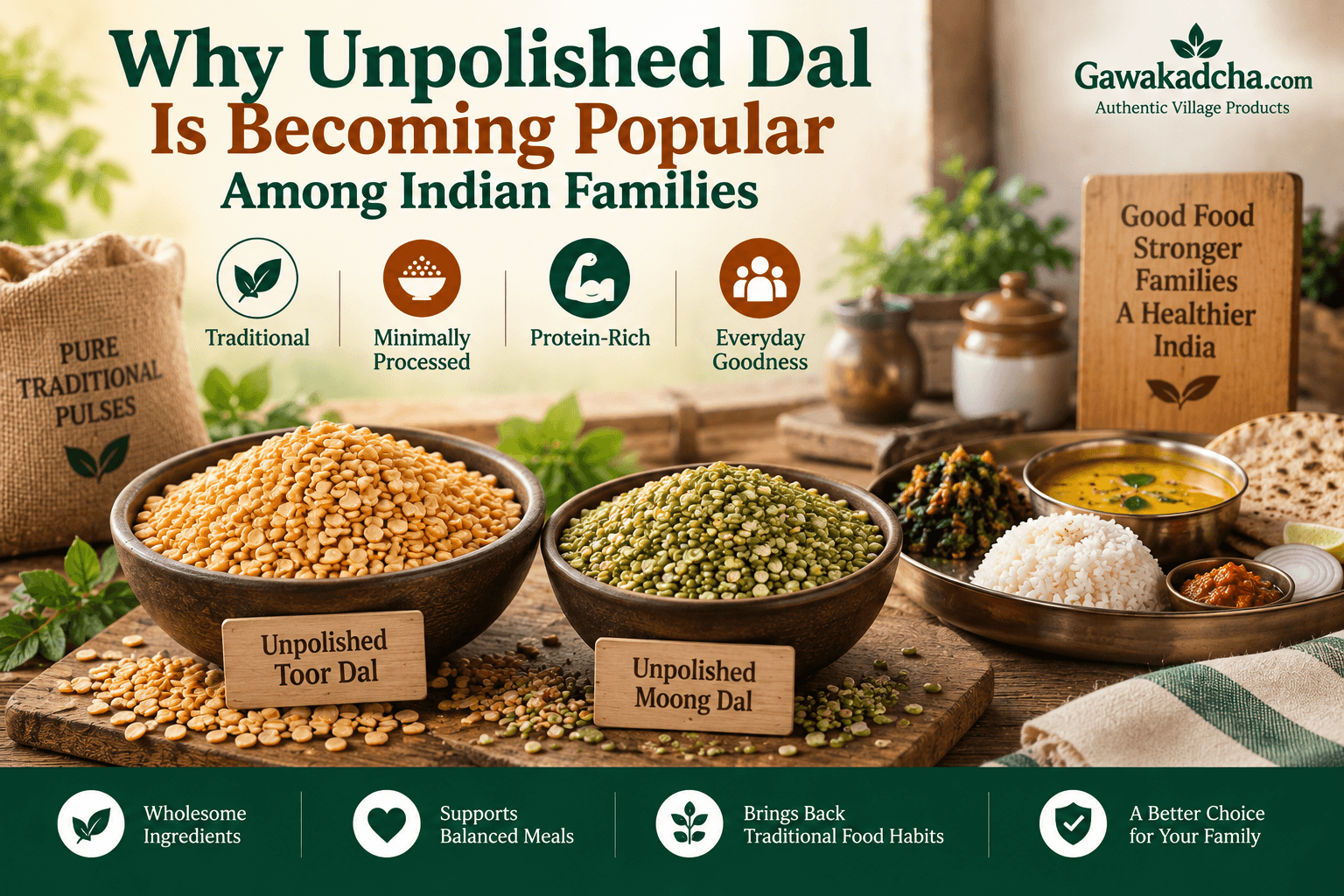
Why Unpolished Dal Is Becoming Popular Among Indian Families
Traditional • Minimally Processed • Wholesome • Everyday Indian Food
Indian kitchens have always had a strong connection with dal. From a simple bowl of dal with rice to Maharashtrian varan-bhaat, dal is an everyday staple in millions of Indian households.
But today's families are becoming more conscious about the ingredients they bring home. Along with traditional foods, there is growing interest in unpolished dal, whole grains and minimally processed grocery products.
So, why is unpolished dal becoming popular among Indian families?
The answer lies in a combination of traditional food habits, awareness about processing, interest in wholesome ingredients and the desire to bring familiar staples back to the kitchen.
In this article, we will understand what unpolished dal means, how it differs from polished dal, why consumers are choosing it and what to consider when buying unpolished pulses online.
What Is Unpolished Dal?
Unpolished dal refers to pulses that have not undergone extensive polishing intended to give them a smoother, shinier appearance.
Depending on the pulse and processing method, some natural outer layers may remain.
Common varieties include:
Unpolished Toor Dal
Unpolished Moong Dal
Unpolished Chana Dal
Unpolished Masoor Dal
Other traditional pulses
The exact processing method can vary between products, so consumers should always check the product information provided by the manufacturer or seller.
The appeal of unpolished dal is largely connected with the idea of choosing less-refined, traditionally processed pulses.
Why Are Indian Families Choosing Unpolished Dal?
Several factors are contributing to the growing interest in unpolished pulses.
1. Growing Interest in Minimally Processed Foods
Consumers are increasingly paying attention to how their food is processed.
Instead of choosing groceries based only on appearance, many families now consider:
Processing method
Ingredients
Source
Packaging
Product information
Quality
Unpolished dal fits naturally into this trend because it is associated with a simpler approach to pulse processing.
For families looking for minimally processed food, unpolished pulses can be an appealing pantry choice.
2. Unpolished Dal Connects With Traditional Indian Food Habits
Long before modern food processing became widespread, pulses were an essential part of Indian diets.
Different regions developed their own traditional dal-based dishes.
For example:
Maharashtra → Varan-Bhaat, Amti, Usal
Punjab → Dal Tadka
South India → Sambar
Gujarat → Gujarati Dal
Rajasthan → Dal-based traditional meals
The renewed interest in unpolished dal is also part of a larger return to traditional Indian food ingredients.
Families are rediscovering the value of simple staples that have been part of Indian cooking for generations.
3. Natural Appearance Is Becoming More Appreciated
Polished dal generally has a smooth and shiny appearance.
Unpolished dal may look more natural and less glossy because it has undergone less cosmetic processing.
For some consumers, this natural appearance communicates a sense of authenticity.
However, appearance alone should never be used to judge nutritional quality or purity.
A trustworthy product should provide clear information about its processing and quality.
4. Pulses Are an Important Part of Indian Meals
Dal is one of the most versatile ingredients in an Indian kitchen.
It can be prepared in many ways:
Dal
Varan
Amti
Khichdi
Usal
Dal fry
Sambar
Dal-based curries
Pulses are also widely valued as sources of plant protein, dietary fibre and other nutrients, depending on the variety.
This makes dal a practical everyday food for families looking to build balanced meals.
5. Unpolished Dal Is Becoming Part of the "Traditional Food" Movement
Across India, consumers are showing renewed interest in foods associated with traditional kitchens.
This includes:
Unpolished pulses
Traditional grains
Millets
Jowar
Bajra
Homemade pickles
Traditional masalas
Cold-pressed oils
This movement is not simply about nostalgia.
Consumers are increasingly interested in understanding where their food comes from and how it reaches their kitchen.
Unpolished Dal vs Polished Dal
One of the most common questions is about the difference between polished and unpolished pulses.
Feature | Unpolished Dal | Polished Dal |
|---|---|---|
Processing | Less polishing | More polishing may be used |
Appearance | Usually more natural-looking | Often smoother and shinier |
Consumer appeal | Traditional/minimally processed preference | Convenience and familiar appearance |
Processing focus | Retains more of the natural exterior in some products | Outer layers may be removed further |
Cooking | Depends on pulse and processing | Depends on variety and processing |
It is important to understand that "unpolished" does not automatically mean "healthier" in every nutritional respect. The variety of pulse, processing, cooking method and overall diet all matter.
What Are the Benefits of Choosing Unpolished Dal?
1. A Traditional Pantry Choice
For families who prefer traditional food products, unpolished dal provides an opportunity to choose pulses with a less-polished processing approach.
2. Useful for Everyday Cooking
Toor, Moong and other dals can be incorporated into numerous everyday Indian recipes.
3. Supports a Balanced Diet
Pulses can contribute protein, fibre and other nutrients to a balanced diet.
4. Fits Modern Interest in Food Transparency
Consumers can pay attention to processing, sourcing and product information instead of choosing food based only on appearance.
5. Brings Traditional Ingredients Back to the Kitchen
Unpolished pulses are part of a wider movement toward traditional Indian ingredients and cooking practices.
Popular Types of Unpolished Dal
Unpolished Toor Dal
Toor dal is one of India's most commonly used pulses.
It is widely used for:
Varan
Dal
Amti
Sambar
Dal fry
For Maharashtrian families, toor dal is especially important in traditional everyday meals.
Unpolished Moong Dal
Moong dal is versatile and can be used for:
Dal
Khichdi
Usal
Soups
Traditional preparations
Its versatility makes it a useful ingredient for everyday cooking.
Unpolished Chana Dal
Chana dal is used in several Indian recipes and can also be incorporated into traditional snacks and preparations.
It is another example of a pulse that has remained an important part of Indian cuisine.
How to Choose Good Unpolished Dal
If you are planning to buy unpolished dal online, don't focus only on the word "unpolished."
Consider these factors.
1. Check Product Information
Look for:
Pulse variety
Net quantity
Manufacturer/producer
Packaging details
Batch information
Best-before information
2. Check Processing Details
Understand whether the product is actually described as unpolished and what processing has been used.
3. Look at Packaging Quality
Good packaging helps protect pulses from:
Moisture
Dust
Insects
Contamination
4. Choose a Reliable Seller
Purchase from a platform that provides transparent product and seller information.
5. Consider Your Cooking Requirements
Choose the dal according to the dishes your family regularly prepares.
Why Buy Unpolished Dal Online?
Earlier, consumers often depended on local grocery stores to find specific types of pulses.
Today, online shopping has made it easier to discover traditional grocery products.
When you buy unpolished dal online, you can:
Compare different products
Read product information
Explore different pulse varieties
Order from home
Discover traditional and rural products
This is particularly useful for consumers living in cities who may have limited access to specialised traditional grocery products.
Unpolished Dal and the Return of Traditional Indian Food
The popularity of unpolished dal is part of something bigger.
Indian consumers are increasingly rediscovering traditional ingredients.
From Jowar and Bajra to unpolished pulses and cold-pressed oils, many traditional products are finding space in modern kitchens.
The idea is not necessarily to reject modern food completely.
Instead, it is about creating a balance:
Modern Convenience + Traditional Ingredients
Online marketplaces are making this combination increasingly accessible.
Discover Unpolished Pulses on Gawakadcha.com
At Gawakadcha.com, customers can explore traditional and rural food products from different categories.
The range includes products such as:
Unpolished Toor Dal
Moong Dal
Organic Jowar
Organic Bajra
Traditional masalas
Homemade pickles
Papad
Shenga chutney
Cold-pressed oils
Traditional snacks
The goal is to make authentic and traditional products easier for modern customers to discover and purchase online.
For families looking to add unpolished pulses to their everyday grocery list, Gawakadcha.com provides a convenient way to explore these traditional staples.
Frequently Asked Questions
Is unpolished dal better than polished dal?
Unpolished dal is preferred by many consumers because it undergoes less polishing. However, "unpolished" does not automatically mean nutritionally superior; the pulse variety, processing and overall diet also matter.
What is unpolished Toor Dal?
Unpolished Toor Dal is toor dal processed without extensive polishing. It is commonly used for dal, varan, amti and other Indian dishes.
Is unpolished dal good for everyday cooking?
Yes. Varieties such as Toor Dal and Moong Dal can be used in many everyday Indian recipes.
Which unpolished dal is best?
There is no single best dal for everyone. Toor, Moong, Chana and Masoor serve different culinary purposes and can be selected according to your family's preferences.
Where can I buy unpolished dal online?
You can explore traditional pulse products, including unpolished dals, through online grocery and traditional-product marketplaces such as Gawakadcha.com.
Why is unpolished dal becoming popular?
Growing interest in traditional foods, minimally processed ingredients, food transparency and healthier overall eating habits is contributing to interest in unpolished pulses.
Conclusion
The growing popularity of unpolished dal among Indian families reflects a broader change in the way people think about everyday food.
Consumers are increasingly interested in traditional ingredients, processing methods and the journey of food from producer to kitchen.
Unpolished Toor Dal, Moong Dal and other pulses can be practical additions to an Indian pantry, especially for families who enjoy traditional meals and want to explore minimally processed grocery choices.
The important thing is to look beyond marketing labels and choose products with clear information, reliable sourcing and suitable quality.
At Gawakadcha.com, traditional pulses and other village products are being brought closer to modern Indian consumers.
Traditional ingredients. Everyday cooking. A connection between village producers and modern kitchens.